

Most facilities managers first heard about NFPA 70B when someone mentioned an inspection or a penalty. That is understandable. Before 2023, NFPA 70B was titled “Recommended Practice for Electrical Equipment Maintenance.” The word “recommended” does a lot of work. It signals guidance, not obligation.
The 2023 edition removed that word entirely. NFPA 70B is now the “Standard for Electrical Equipment Maintenance.” A standard, in NFPA language, carries mandatory requirements wherever it is adopted by the authority having jurisdiction. That is the jurisdiction you are operating in right now.
This article covers what specifically changed in 2023, what the standard now requires, and what a compliant electrical maintenance program actually looks like.
What NFPA 70B Was Before 2023
NFPA 70B has existed since 1970. For most of its history, it was a recommended practice document. The NFPA published it to guide facilities and contractors on how to maintain electrical systems safely, but compliance was essentially voluntary.
Prior editions used “should” throughout the text. In NFPA terminology, “should” indicates a recommendation. Facilities could follow it or not. Inspectors might reference it, but there was no clear enforcement hook.
The previous edition before 2023 was published in 2019. Even that version maintained the recommended practice framing. Some facilities followed it rigorously. Many had never heard of it.
That changed with the 2023 revision cycle.
The 2023 Shift: From “Should” to “Shall”
The most consequential change in the 2023 edition is linguistic, and it matters enormously. The standard now uses “shall” instead of “should” throughout its requirements sections.
Section 3.2.5 of NFPA 70B defines this directly: “Shall. Indicates a mandatory requirement.” That definition is not accidental. NFPA uses consistent terminology across all its codes, and the shift from “should” to “shall” is how a recommendation becomes a legal obligation.
So when Section 4.2.1 now reads “The equipment owner shall implement and document an Electrical Maintenance Program,” that is not optional. It is required. Wherever NFPA 70B has been adopted, failing to have a documented EMP is a compliance violation.
Many facilities are still operating as if the pre-2023 guidance applies. It does not.
What the 2023 Standard Now Requires
The 2023 edition is not just a rebranding. Several specific requirements are new or substantially strengthened. Here is what facilities are now accountable for. For a section-by-section breakdown, see our full NFPA 70B requirements guide.
A Documented Electrical Maintenance Program
Section 4.2.1 requires the equipment owner to implement and document an EMP that directs activity for all equipment included in the program. Not a spreadsheet, not an informal schedule. A formal, documented program. This includes written maintenance procedures, inspection protocols, and a process for corrective action when equipment fails. See our guide to creating an Electrical Maintenance Program.
A Named EMP Coordinator
Section 4.3.1 requires the equipment owner to identify a specific EMP coordinator. Someone has to own this program. That person is responsible for implementation, oversight, and keeping the program current. For larger facilities, this is typically a facilities manager or plant engineer. For smaller operations, it may be a contractor.
Documented Training for Maintenance Personnel
Section 4.3.3.4 requires training to be documented whenever a person completes the required maintenance training. That record has to specify what was covered, who received it, and when. It must be retained for the duration of employment. Annual supervisory checks are also required to confirm personnel are following the procedures.
Regular EMP Audits
Section 4.2.7 requires the EMP to be audited at intervals not exceeding five years. The audit must verify that the program’s principles and procedures still comply with the standard. This is not an internal review. It needs to be a documented audit that could hold up under inspection.
How Gimba Handles This
Your Documented EMP in One Click
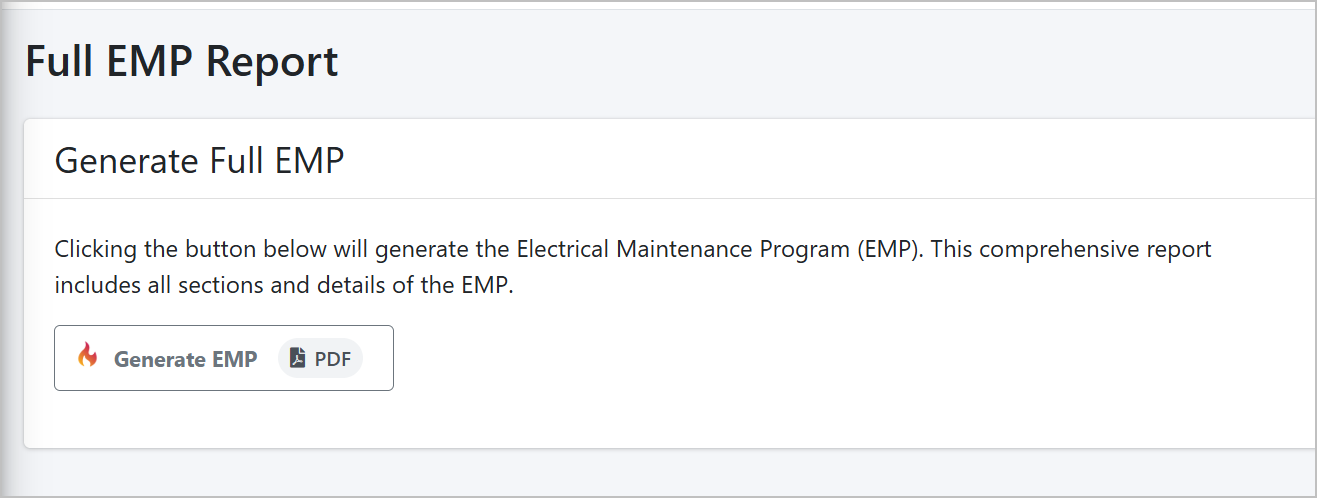
The 2023 standard requires a documented EMP. Gimba generates one that is complete and audit-ready in a single click. Not a template you fill out. A finished program, built from your actual equipment inventory, structured to meet NFPA 70B section by section.
Most facilities spend weeks pulling this together manually. With Gimba, same-day onboarding means you can have your EMP before the end of the day you sign up.
Equipment Condition Assessments Are Now Part of the Program
The 2023 edition formalized the equipment condition assessment as a required component of the EMP, not just a best practice. Section 4.2.3 requires the program to include elements that consider “current condition of maintenance of electrical equipment and systems as well as the potential safety and operational risks.”
In practice, that means walking through each piece of equipment, evaluating its condition against defined criteria, and recording the results. For many facilities, this is the hardest part. Condition assessments require technical knowledge, consistent methodology, and a lot of fieldwork.
Doing it once is manageable. Doing it on a recurring basis, across hundreds of assets, with documentation that holds up under audit: that is where most facilities struggle. The standard also specifies required inspection methods, including infrared thermography, on a defined schedule.
How Gimba Handles This
Guided Assessments That Anyone Can Run
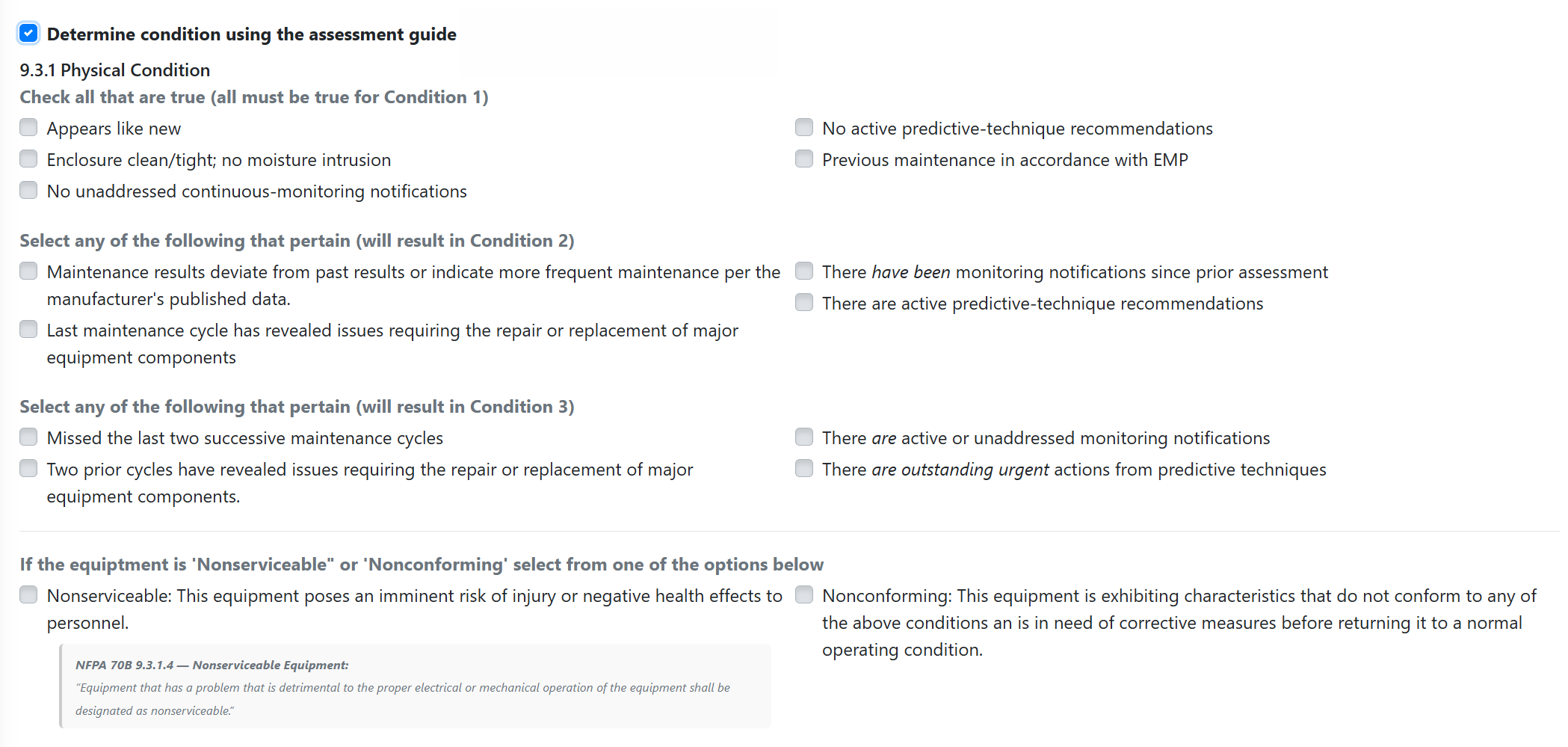
Gimba walks technicians through NFPA 70B condition assessments section by section. No guesswork, no expertise required. The system prompts the right questions for each equipment type, captures the responses, and flags anything that needs follow-up.
Every assessment is logged with a timestamp, the technician’s name, and the findings. That is the documentation the 2023 standard requires, created automatically as you work.
Who Enforces NFPA 70B 2023?
NFPA does not directly enforce its own standards. Enforcement happens through adoption by state and local jurisdictions. When a state, city, or county formally adopts NFPA 70B 2023, it becomes part of local code and inspectors can cite violations. For a full breakdown of adoption status by jurisdiction, see our guide on whether NFPA 70B is mandatory.
OSHA enforces electrical safety through the General Duty Clause, which requires employers to protect workers from recognized hazards. An inadequate electrical maintenance program can constitute a recognized hazard, particularly if an incident occurs and the facility cannot demonstrate a functioning EMP.
Insurance carriers are another pressure point. Underwriters for industrial and commercial property increasingly require evidence of electrical maintenance programs as a condition of coverage. Some carriers specifically reference NFPA 70B compliance in their policy language.
Beyond formal enforcement, the practical risk is operational. Electrical failures cause downtime, fires, and injuries. The facilities most exposed are the ones with no program at all.
What Facilities Need to Do Right Now
If your facility does not have a documented EMP, that is the starting point. Everything else builds on that foundation: training records, audit cycles, condition assessments.
Inventory your electrical equipment.
You cannot build a maintenance program around equipment you have not documented. Pull your single-line diagram, walk the facility, and build an asset list with nameplate data for each piece of equipment.
Assign an EMP coordinator.
Section 4.3.1 is explicit. One person has to own the program. That does not mean they do all the work, but they are the accountable party. Name that person now, even if the EMP itself is still being built.
Build and document the EMP.
This is the bulk of the work. Maintenance procedures, inspection frequencies, corrective action processes, personnel qualifications: all of it needs to exist in writing, organized around your specific equipment and operating environment.
Conduct initial condition assessments.
Once the program is documented, start running assessments against it. Flag equipment in poor condition for immediate attention. That creates the feedback loop the standard is designed to produce.
Ready to Get Your EMP Done?
Gimba builds your NFPA 70B-compliant Electrical Maintenance Program in one click. Same-day onboarding, flat-rate pricing, and audit-ready from day one.
Frequently Asked Questions
What changed between NFPA 70B 2019 and NFPA 70B 2023?
The 2019 edition was called “Recommended Practice for Electrical Equipment Maintenance.” The 2023 edition is titled “Standard for Electrical Equipment Maintenance.” That title change is not cosmetic. It means requirements throughout the document are now mandatory wherever the standard is adopted, rather than voluntary guidance. The shift from “should” to “shall” throughout the text makes this enforceable.
Is NFPA 70B 2023 legally required at my facility?
It depends on whether your jurisdiction has adopted it. States and municipalities adopt NFPA codes on their own schedules. Check with your local authority having jurisdiction (AHJ) to confirm current adoption status. Even without formal adoption, OSHA’s General Duty Clause creates liability for facilities without a functional electrical maintenance program, particularly after an incident.
Where can I get the NFPA 70B 2023 PDF?
The full standard is available for purchase through NFPA at nfpa.org. A free read-only version is available on the NFPA website through their online access program. If you are looking for a practical starting point before purchasing the full document, Gimba offers a free NFPA 70B compliance spreadsheet that covers the key program requirements.
Is there a newer edition after 2023?
Yes. NFPA published the 2026 edition, which builds on the mandatory framework established in 2023. Most jurisdictions are still in the process of adopting 2023. The core requirements carry through both editions: documented EMP, named coordinator, training records, regular audits.
How long does it take to build an NFPA 70B-compliant EMP?
Building one from scratch manually can take weeks, especially for facilities with large or complex electrical systems. Consultants typically charge several thousand dollars and still hand you a template you have to populate. Gimba generates a complete, site-specific EMP in one click from your equipment inventory. Onboarding takes a day, not weeks.
Related reading: NFPA 70B Overview | NFPA 70B Compliance Checklist | Electrical Maintenance Program Guide | How to Comply with NFPA 70B | NFPA 70B vs NFPA 70E
