

Ask most facilities managers what NFPA 70B requires and you will get a vague answer. That is partly because most people learned about the standard from a contractor’s proposal or a compliance checklist, not from the standard itself.
The 2023 edition is specific. It uses mandatory language throughout – “shall” rather than “should” – and it defines exactly what a compliant electrical maintenance program must include. Section 3.2.5 of the standard defines “shall” as a mandatory requirement. No ambiguity.
What follows is a structured breakdown of the core requirements, organized by category. This is not a substitute for reading the standard, but it gives you a clear picture of what your facility is expected to have in place.
Requirement 1: A Documented Electrical Maintenance Program
Section 4.2.1 is the foundation: “The equipment owner shall implement and document an EMP that directs activity for the maintenance of equipment included in the EMP.”
That sentence has three distinct obligations. You have to implement a program. You have to document it. And the documentation has to direct actual activity – it cannot be a theoretical document that sits in a binder.
Section 4.2.4.2 lists what the program must include:
- A statement of the principles the program is based on and the goals it aims to achieve
- Identification of the people responsible for each element of the program
- A survey and analysis of equipment to determine maintenance requirements and priorities
- Developed and documented maintenance procedures for each type of equipment
- A process for collecting, recording, and analyzing condition data
- A process for implementing and documenting corrective measures
- A review and revision process that incorporates failures and findings over time
The program also has to be audited at intervals not exceeding five years (Section 4.2.7). That audit must verify the program’s procedures comply with the current standard.
Requirement 2: A Named EMP Coordinator
Section 4.3.1: “The equipment owner shall identify an EMP coordinator.”
Someone has to be accountable for the program. The standard defines the EMP coordinator as the individual responsible for implementation and operation of the EMP (Section 3.3.18). That is a real person with a real job function, not a shared responsibility that belongs to no one in particular.
For many facilities, this is the facilities manager or plant engineer. For operations that use an electrical contractor for maintenance, the contractor’s point of contact may serve this role. Either way, the standard requires the role to be identified.
Section 4.3.2 requires that all personnel assigned to EMP duties be qualified for the tasks they are assigned to. Qualification means having the right training and competency – not just a job title.
Requirement 3: Documented Training Records
Section 4.3.3.4 requires that training be documented in a specific way:
- Documentation must be issued when the person demonstrates proficiency in the required maintenance procedures
- Records must be retained for the full duration of the person’s employment
- The documentation must specify the content of the training, the person’s name, and the dates
Section 4.3.3.2 adds annual supervision or inspections to verify each employee is following the maintenance procedures required for their work tasks. That annual check also needs to be documented.
This is where many facilities fall short. They train their people, but the records are informal, incomplete, or stored in ways that cannot survive an audit.
How Gimba Handles This
Every Requirement Met Out of the Box
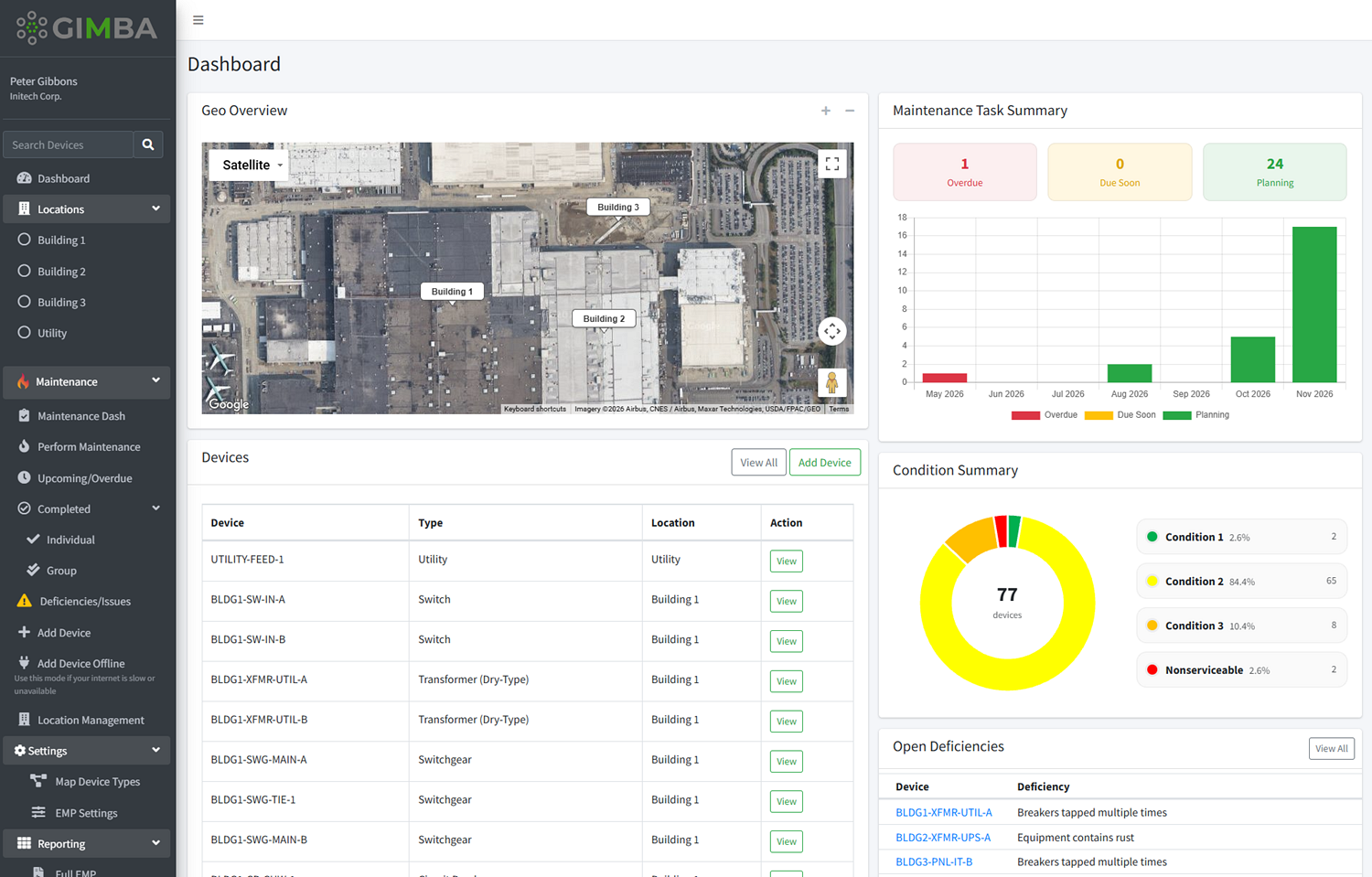
Gimba generates your documented EMP in one click, assigns your EMP coordinator role, and logs every assessment with a timestamp and technician record. The documentation the standard requires gets created automatically as your team works.
When an auditor asks for records, you pull a report. Not days of preparation. One report.
Requirement 4: Equipment Condition Assessments
Section 4.2.3 requires the EMP to include elements that consider the “current condition of maintenance of electrical equipment and systems as well as the potential safety and operational risks.” This means structured, documented condition assessments – not just reactive maintenance after something fails.
Chapter 9 of the standard specifies maintenance intervals by equipment type and condition. Infrared thermography, for example, is required annually for all equipment in Condition 1 or 2, and every six months for equipment in Condition 3 (Table 9.3.2). These intervals are mandatory, not suggested frequencies.
Section 4.4 requires a survey and analysis to determine the appropriate scope and frequency of maintenance for each piece of equipment, factoring in environmental conditions, load, and failure risk.
Requirement 5: Planned Inspections With Documented Corrective Action
Section 4.5 requires planned inspections based on specific factors: potential for equipment failure to endanger personnel, manufacturer recommendations, operating environment, and load conditions.
Inspections are not the end of the requirement. Section 4.2.4.2 requires a process to prescribe, implement, and document corrective measures based on collected data. If an inspection finds a problem, the standard requires a documented path from finding to correction.
Section 4.2.6 extends this further, requiring the EMP to use incident reports – including safety incidents, near misses, and protective device operations – as feedback for refining the program. Failures are supposed to improve the program, not just get repaired and forgotten.
Build Your Compliant EMP Today
Gimba generates a documented Electrical Maintenance Program that meets NFPA 70B requirements. One click, same-day onboarding, flat-rate pricing.
Frequently Asked Questions
What is the main requirement of NFPA 70B?
The central requirement is that every equipment owner shall implement and document an Electrical Maintenance Program (Section 4.2.1). The EMP must cover inspection procedures, personnel qualifications, condition assessments, and corrective action processes. It must also be audited at intervals not exceeding five years.
Does NFPA 70B require written documentation?
Yes. The standard explicitly requires that the EMP be documented (Section 4.2.1), that maintenance procedures be written (Section 4.2.4.2), and that training records be retained in writing for the duration of employment (Section 4.3.3.4). Verbal programs or informal spreadsheets do not satisfy these requirements.
Who is responsible for NFPA 70B compliance at a facility?
The standard places responsibility on the equipment owner, who must designate an EMP coordinator (Section 4.3.1). That coordinator is accountable for implementation and ongoing operation of the program. In practice, this is typically the facilities manager, plant engineer, or an electrical contractor serving in that role.
How often does NFPA 70B require inspections?
Chapter 9 of NFPA 70B specifies maintenance intervals by equipment type and condition. Infrared thermography is required at least annually for equipment in good condition and every six months for equipment in poor condition. Battery visual inspections are required monthly for Condition 3 equipment. The EMP must reflect these intervals and document that they are being met.
Related reading: NFPA 70B Overview | NFPA 70B 2023: What Changed | NFPA 70B Compliance Checklist | Electrical Maintenance Program Guide | How to Comply with NFPA 70B
