

Infrared thermography – running a thermal camera over electrical panels, switchgear, and connections while they are under load – has been standard practice in electrical maintenance for decades. Most experienced electricians know it catches problems before they fail. What changed in NFPA 70B 2023 is that “knowing it’s a good idea” is no longer good enough.
The standard now requires it. Section 7.2.1.1 states that infrared thermographic inspection of electrical connections and terminations “shall be performed in accordance with Section 7.4.” Section 7.4 defines exactly how.
This article covers what NFPA 70B requires for thermography inspections, how to conduct them correctly, what the documentation requirements are, and what to do when you find a problem.
Why NFPA 70B Requires Infrared Inspections
Loose connections and degraded terminations generate heat before they fail. A thermal camera can detect temperature anomalies that are invisible to the naked eye – a connection running 40 degrees above the reference point is a fire waiting to happen, but it looks fine on visual inspection.
NFPA 70B uses this principle as the basis for a required maintenance task rather than an optional one. The standard’s overall goal is to identify the condition of maintenance of electrical equipment before that condition causes a safety incident or production loss. IR scanning is one of the most direct ways to do that.
Section 7.4.1 defines the core purpose: infrared thermography shall be used to verify temperature differences – comparing similar electrical components under similar loading, and comparing components against ambient air temperature. When those differences are outside acceptable ranges, corrective action is required.
What Section 7.4 Requires During an IR Inspection
The standard does not just require you to point a camera at equipment. There are specific conditions that must be met for an IR inspection to satisfy the requirement:
Covers Must Be Removed
Section 7.4.2 requires that all accessible and necessary covers be removed prior to the inspection to provide a clear line of sight to the equipment being scanned. Scanning through closed panels is not permitted as a substitute. The standard is explicit: you need to see the actual connections and terminations.
Equipment Must Be Under Operating Load
Section 7.4.4 requires that infrared thermography inspections be performed with the equipment online and at operating load. A loose connection does not generate heat when there is no current running through it. Scanning de-energized or lightly loaded equipment will miss the exact conditions that cause failures. For facilities that run at partial load during the day, this may require scheduling IR inspections during peak production hours.
Temperature Differences Must Be Documented
Section 7.4.3 requires that temperature differences between the area of concern and the reference area be documented. Documenting means recording the actual values – not just a note that the scan was completed. The delta-T between a hot connection and its reference point is the data that determines severity and drives corrective action.
How Often NFPA 70B Requires IR Inspections
Table 9.3.2 in Chapter 9 specifies maintenance intervals by equipment type and condition rating. For infrared thermography specifically:
- Condition 1 (good condition): IR thermography every 12 months
- Condition 2 (fair condition): IR thermography every 12 months
- Condition 3 (poor condition): IR thermography every 6 months
These intervals apply to all equipment covered by the EMP. A facility with 200 pieces of electrical equipment needs 200 IR inspections completed within the required window – tracked by equipment, not by a blanket “we did an IR sweep last year” notation.
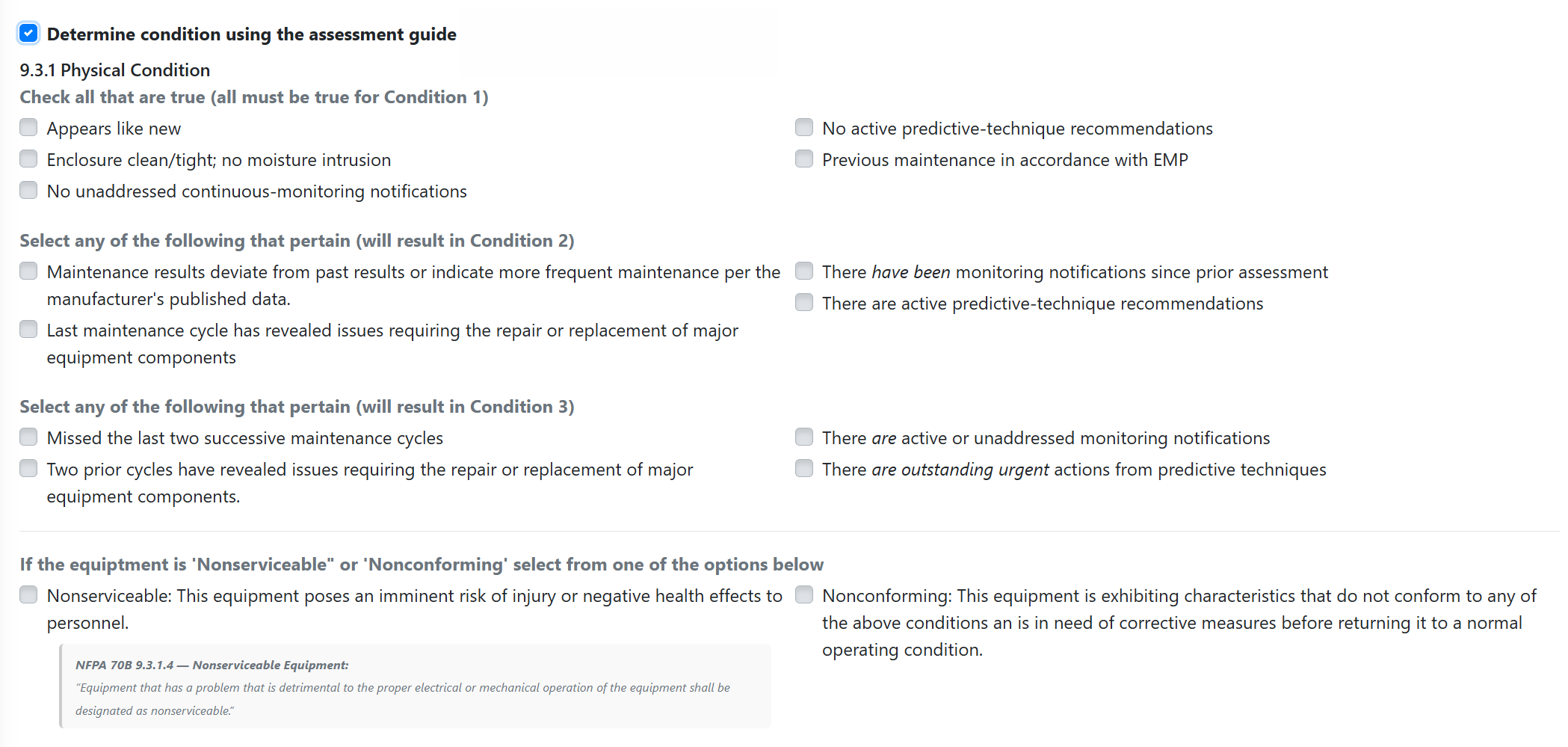
The condition rating itself is established through the equipment condition assessment process. Equipment that starts at Condition 1 can move to Condition 3 if maintenance lapses – which triggers more frequent inspections, not fewer.
How Gimba Handles This
Track Every IR Inspection by Equipment
Gimba tracks maintenance schedules and condition ratings at the equipment level. When an IR inspection is due on a specific piece of switchgear, the system flags it. When the inspection is complete, the technician logs the findings – including temperature differentials – directly in the platform.
If equipment moves from Condition 1 to Condition 3, the inspection interval automatically adjusts. No manual calendar updates. No missed deadlines discovered during an audit.
What to Do When You Find a Hot Spot
A thermal anomaly does not automatically require immediate shutdown, but it does require documentation and a corrective action decision. The severity classification commonly used in IR inspections is based on temperature difference:
- Minor (1-10°C above reference): Document, monitor at next scheduled inspection
- Intermediate (11-25°C above reference): Schedule repair within a maintenance window
- Serious (26-40°C above reference): Repair as soon as possible
- Critical (over 40°C above reference): Take equipment out of service, repair immediately
NFPA 70B’s Section 4.2.4.2 requires a documented process for corrective measures based on collected data. The thermal camera finding is not the end – the corrective action decision, and its documentation, is also part of the required program.
The standard also requires that incident reports, including those generated by equipment failures following missed maintenance, feed back into the EMP as lessons. If a panel arcs and the investigation shows the last IR scan was overdue, that gap becomes a required input for program improvement under Section 4.2.6.
Keep Every IR Inspection on Schedule
Gimba tracks thermography intervals by equipment, flags what’s due, and stores every finding in your documented EMP. Audit-ready from day one.
Frequently Asked Questions
Does NFPA 70B require infrared thermography?
Yes. Section 7.2.1.1 states that infrared thermographic inspection of electrical connections and terminations shall be performed in accordance with Section 7.4. The word “shall” in NFPA terminology indicates a mandatory requirement. Table 9.3.2 specifies that IR thermography is required at least annually for all equipment, more frequently for equipment in poor condition.
Can you do an infrared inspection with panels closed?
No. Section 7.4.2 requires that all accessible and necessary covers be removed to provide a clear line of sight to the equipment being scanned. Scanning through closed doors or covers does not satisfy the requirement, because heat signature readings are affected by the panel material and any thermal insulation in the enclosure.
Does NFPA 70B require thermography on de-energized equipment?
No – the opposite. Section 7.4.4 requires that infrared thermography inspections be performed online with an operating load. Temperature anomalies caused by loose connections or failing components only appear when current is flowing through them. Scanning during scheduled shutdowns or at reduced load will miss these conditions.
What qualifications are required for someone performing IR inspections?
Section 4.3.2 requires that personnel assigned to EMP duties be qualified for the assigned tasks. For IR thermography, that typically means training in thermographic inspection methods, proper camera operation, and interpretation of results. Many contractors who specialize in IR electrical inspections carry ASNT Level I or II thermographer certification, which satisfies the qualification requirement.
What should an NFPA 70B thermography report include?
At minimum: the equipment inspected, the date and load conditions at time of inspection, the thermal images, temperature differentials documented for any anomalies found (Section 7.4.3), a severity classification, and the recommended corrective action. This report becomes part of your EMP documentation and should be retained for audit purposes.
Related reading: NFPA 70B Overview | NFPA 70B Requirements Guide | NFPA 70B Condition Assessment | NFPA 70B Maintenance Intervals | Electrical Maintenance Program Guide
