

NFPA 70B COMPLIANCE
How to Comply with NFPA 70B
Compliance does not start with paperwork. It starts with understanding what the standard actually requires, then building a program that can prove it.
What NFPA 70B Compliance Actually Means
NFPA 70B requires facilities to have an ongoing electrical maintenance program. Not a one-time inspection. Not a binder that gets updated every few years. An active, documented system for inspecting, testing, and maintaining electrical equipment on a defined schedule.
The 2023 edition changed the standard’s language from recommended to shall throughout. That shift matters. It means the steps below are not suggestions. They are what the standard requires.
Whether your jurisdiction has formally adopted 70B affects enforcement. The compliance framework is the same either way.
Step 1: Know What Applies to Your Facility
NFPA 70B covers electrical, electronic, and communications equipment in commercial and industrial facilities. For most facilities this means switchgear, transformers, panelboards, motor control centers, UPS systems, generators, and distribution equipment.
Start by walking the facility and identifying every piece of electrical equipment that falls within scope. This becomes your asset list. Everything in your maintenance program flows from it. A facility that skips this step ends up with gaps in its EMP that are easy for an auditor to find.
Nameplate data matters here. Manufacturer, model, voltage, capacity, installation date. The maintenance requirements in Chapter 9 are tied to equipment type and manufacturer recommendations, so the more complete your asset records, the more accurate your program will be.
Step 2: Establish Your Electrical Maintenance Program
The Electrical Maintenance Program is the core document that NFPA 70B requires. It defines the scope of your program, who is responsible for what, how maintenance is to be performed, and how everything gets documented.
A compliant EMP needs to cover the following at minimum: the facility and equipment in scope, the qualifications of personnel performing maintenance, the procedures for each equipment type, the inspection and testing frequencies, and the process for identifying and resolving deficiencies.
Most facilities that struggle with compliance get stuck here. Writing a full EMP from scratch is a significant project. It requires pulling together manufacturer documentation, cross-referencing Chapter 9 intervals, and structuring everything into a document that holds up to scrutiny. See what an EMP must include or follow the step-by-step guide to creating one.
How Gimba Handles This
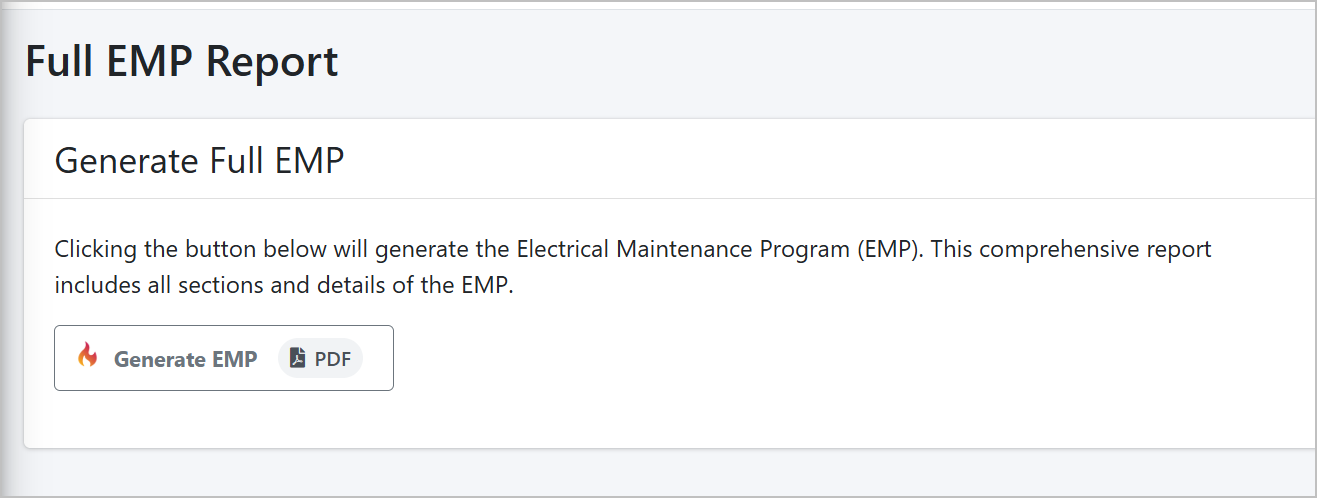
A Complete EMP in One Click
Gimba generates a complete, audit-ready EMP automatically. Every required section is covered. Responsible personnel, maintenance procedures, inspection schedules, condition records. Not a template to fill in. A finished document built from your actual facility data.
Same-day onboarding. Flat-rate pricing. No consultant needed. See how it works.
Step 3: Conduct Baseline Condition Assessments
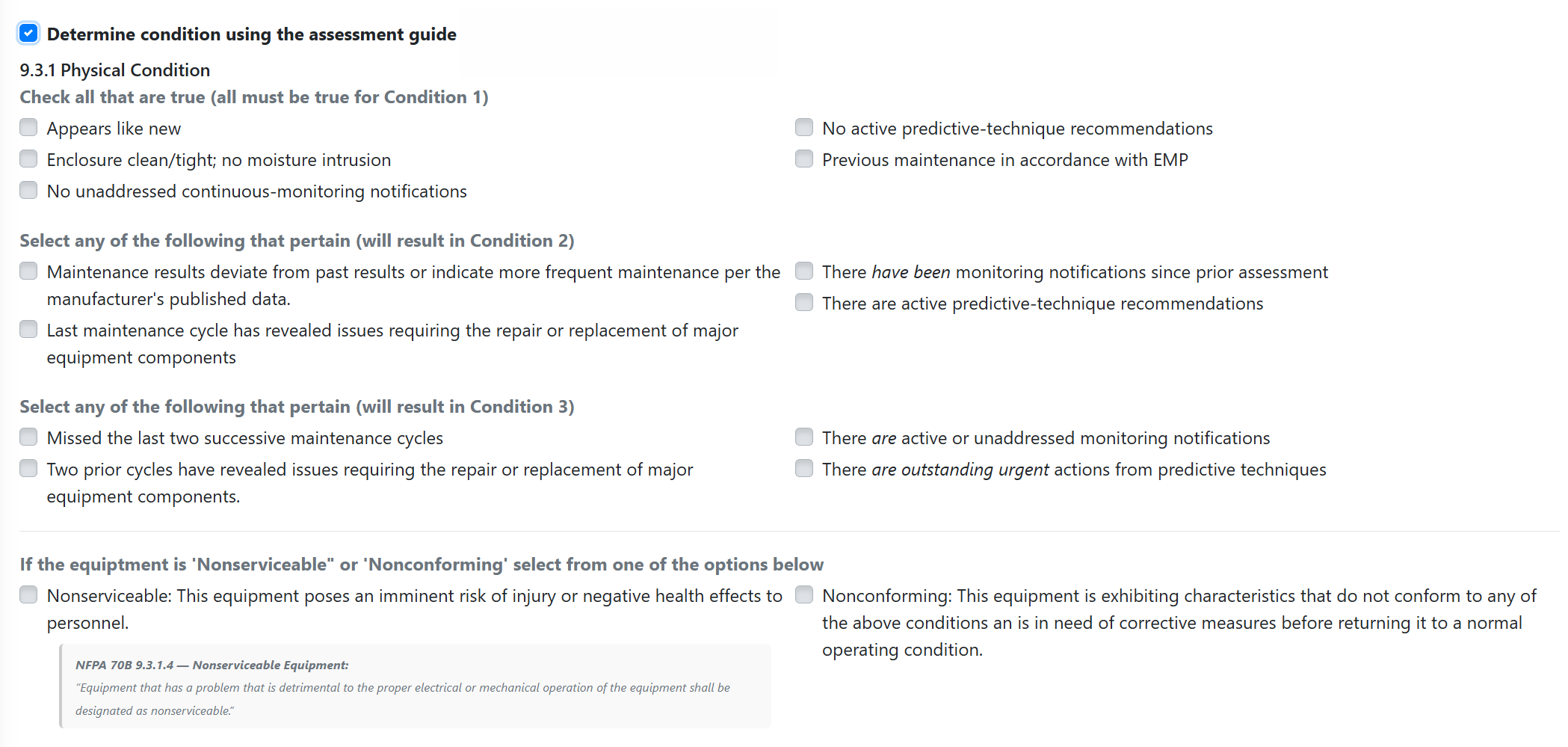
Before you can maintain equipment on a schedule, you need to know what condition it is in right now. NFPA 70B requires condition assessments as part of the ongoing maintenance program. The baseline assessment is where that starts.
A condition assessment covers the physical state of equipment, signs of wear, overheating, corrosion, or deterioration, testing results where applicable, and any deficiencies that need corrective action. It is the starting point for your maintenance schedule and the record that shows your program is active.
For large facilities with significant electrical infrastructure, this step takes time. Technicians need to work through each piece of equipment systematically. The condition assessment process is where NFPA 70B expertise matters most. An AI-guided assessment tool removes the guesswork for technicians who are not 70B specialists.
How Gimba Handles This
Guided Assessments, Section by Section
Gimba walks technicians through each NFPA 70B condition assessment section by section. No expertise required. The system asks the right questions, captures photo documentation, and records results directly to the equipment record. Every assessment feeds into the EMP automatically.
Step 4: Set Maintenance Intervals and Build Your Schedule
Chapter 9 of NFPA 70B provides maintenance intervals by equipment type. These are the minimum frequencies for inspection, testing, and servicing. Equipment manufacturer recommendations must also be factored in. Where the two differ, the more conservative interval applies.
Common intervals under 70B run annually for most switchgear and distribution equipment, with some equipment requiring more frequent attention based on operating environment, age, and condition assessment results. A facility with older equipment or harsh operating conditions may need tighter intervals than the Chapter 9 defaults.
The schedule needs to be documented in your EMP and followed. A maintenance interval that exists on paper but is not executed is not compliance. It is a liability.
How Gimba Handles This
Your Maintenance Schedule, Built from Chapter 9
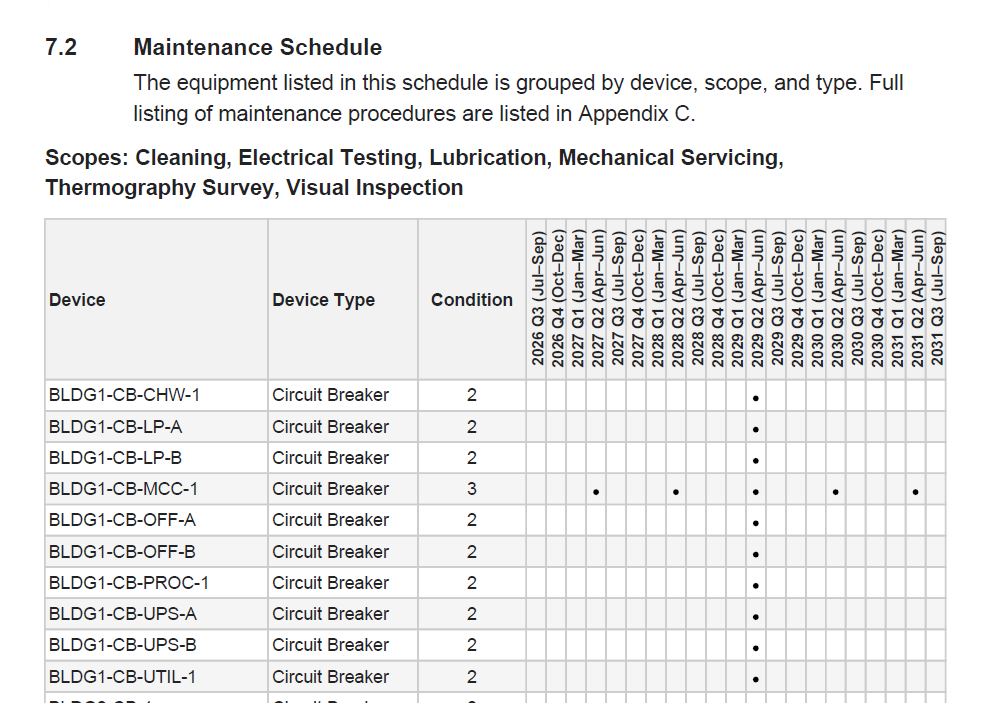
Gimba maps every piece of equipment in your facility to the correct NFPA 70B maintenance intervals from Chapter 9. No manual cross-referencing. No spreadsheets. The system builds your maintenance schedule automatically and exports it as part of the EMP.
The report shows every asset, what needs to be done, and when. Pull it any time for an audit, an insurance inspection, or a new technician getting up to speed on the program. The schedule stays current as condition assessment results come in.
See how Gimba builds your maintenance schedule or download the free NFPA 70B spreadsheet to get a feel for the interval requirements yourself.
Step 5: Document Everything and Keep It Current
Documentation is what separates a compliance program from a compliance claim. NFPA 70B requires records of all maintenance performed, condition assessments completed, deficiencies identified, and corrective actions taken.
These records serve two purposes. First, they prove your program is active when an insurer, authority having jurisdiction, or OSHA inspector asks. Second, they give your own team the maintenance history needed to make informed decisions about equipment. A transformer that has been running clean for five years gets treated differently than one that flagged a thermal anomaly last spring.
The EMP itself needs periodic review. Equipment gets added, removed, or replaced. Operating conditions change. Personnel changes. The program needs to reflect current reality. An EMP that was accurate three years ago and has not been touched since is not a compliant EMP. The consequences of a lapsed program are the same as having no program at all.
Get Compliant in One Day. Not One Month.
Gimba handles the EMP, condition assessments, maintenance scheduling, and documentation in one system. Same-day onboarding. Flat-rate pricing.
Frequently Asked Questions
How long does it take to become NFPA 70B compliant?
The timeline depends on facility size and the current state of your documentation. Building an EMP from scratch the traditional way takes weeks. With Gimba, the EMP generates automatically once your equipment data is in the system. Most facilities complete onboarding and have a compliant EMP the same day.
Do I need a consultant to build an NFPA 70B program?
Not necessarily. A consultant can help interpret requirements for complex facilities, but the structure of NFPA 70B is well-defined. Software purpose-built for the standard handles the EMP structure, condition assessment framework, and maintenance interval scheduling without external help. Consulting is an option, not a requirement.
What is the difference between NFPA 70B and NFPA 70E compliance?
NFPA 70B covers electrical equipment maintenance. NFPA 70E covers worker safety practices around energized electrical equipment. A facility needs both. Gaps in 70B maintenance are often what create the unsafe conditions 70E is designed to protect workers from.
What happens if we fail an NFPA 70B audit?
The consequences depend on who is auditing and why. An insurance inspection that finds no EMP can affect coverage. An authority having jurisdiction can require corrective action. An OSHA inspection following an incident will use the absence of a maintenance program against you. See the full breakdown of non-compliance consequences.
Does NFPA 70B apply to all facilities?
NFPA 70B applies to commercial and industrial facilities with electrical, electronic, and communications equipment. Data centers, hospitals, manufacturers, municipalities, and food processing facilities are among the most common types in scope. Residential properties are generally outside the standard’s scope.
Related: NFPA 70B 2023: What Changed | Full NFPA 70B Requirements Guide
Related: NFPA 70B 2023: What Changed | NFPA 70B Requirements Guide
Related reading: NFPA 70B Overview | EMP Requirements Explained | NFPA 70B Maintenance Intervals | NFPA 70B and OSHA
