

NFPA 70B + OSHA
Is NFPA 70B Required by OSHA?
Technically no. But the General Duty Clause gives OSHA a clear path to cite facilities that have no electrical maintenance program and do not comply with NFPA 70B.
The Short Answer
OSHA does not cite NFPA 70B by name in its regulations. You will not find it referenced in 29 CFR 1910. That is the technically correct answer to the question.
It is also incomplete.
The more useful question is whether OSHA can hold a facility accountable for electrical equipment failures when no maintenance program exists. The answer to that is yes. And that is where NFPA 70B enters the picture.
The General Duty Clause
Section 5(a)(1) of the Occupational Safety and Health Act requires every employer to provide a workplace free from recognized hazards that are causing or likely to cause death or serious physical harm. This provision is commonly called the General Duty Clause.
OSHA uses consensus standards to define what counts as a recognized hazard. NFPA 70B is a consensus standard developed by the National Fire Protection Association. When an electrical incident occurs at a facility without a documented maintenance program, inspectors can point to NFPA 70B as the industry benchmark for what proper maintenance looks like. The standard exists. The industry knows about it. Not following it becomes evidence of an unaddressed recognized hazard.
Not having a program does not automatically create a citation. But having an incident without a program gives OSHA everything it needs to build a General Duty Clause case.
What Changed in 2023
Before 2023, NFPA 70B used the word recommended throughout. Facilities could reasonably argue that their approach was different but still acceptable. The 2023 revision changed that language to shall, turning every recommendation into a requirement.
That matters for OSHA purposes. A consensus standard using mandatory language carries more weight as evidence of what constitutes a recognized hazard. The stronger the standard, the stronger the General Duty Clause argument. Whether NFPA 70B is legally mandatory depends on your jurisdiction, but the OSHA exposure exists regardless.
Facilities that were comfortable ignoring 70B under the old recommended language have less cover under the 2023 version.
Where OSHA and NFPA 70B Overlap Directly
OSHA Subpart S (29 CFR 1910.303 through 1910.399) requires that electrical equipment be maintained in a safe condition. NFPA 70B specifies how that maintenance should be performed, documented, and scheduled. The two are not the same document, but they address the same underlying requirement.
NFPA 70E, which OSHA references more explicitly for arc flash protection and lockout/tagout procedures, shares significant overlap with 70B. An inspection that surfaces a 70E violation will often expose a 70B gap as well. The two standards work together. A facility serious about one should be following both.
The specific maintenance intervals in NFPA 70B Chapter 9 are what give inspectors a concrete benchmark. If a transformer or switchgear panel has no maintenance history and the equipment manufacturer recommends annual servicing, that gap is documentable.
How Gimba Handles This
Your EMP, Ready Before the Inspector Arrives
When OSHA asks for documentation, you need a current Electrical Maintenance Program. Not a spreadsheet from three years ago. A complete EMP with condition assessments, maintenance history, equipment records, and qualified personnel documentation.
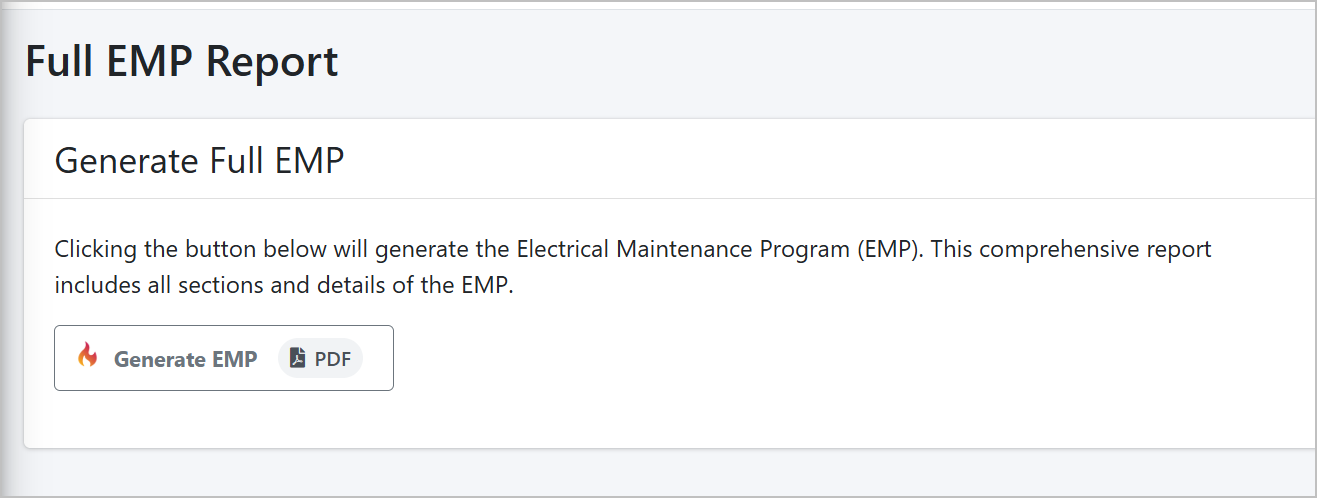
Gimba generates an audit-ready EMP in one click. Every section NFPA 70B requires is covered. Every piece of documentation an OSHA inspector would ask for is in the system. The facilities that handle inspections well built their documentation program before anything went wrong.
See how Gimba works or download the free NFPA 70B compliance spreadsheet to get started.
What Inspectors Actually Look For
OSHA electrical inspections typically follow an incident. A fire, an arc flash, a failure, an injury. When the inspector arrives, the documentation they want to see is predictable.
They will ask for your electrical maintenance program. Maintenance logs for the equipment involved in the incident. Condition assessment records. Training documentation for personnel who work on or near electrical equipment. Evidence that your maintenance schedule aligns with equipment manufacturer requirements and the applicable standard.
NFPA 70B provides the structure for all of it. A facility following the standard has most of this documentation as a byproduct of normal operations. A facility without a program has a documentation problem on top of an incident problem.
The consequences of non-compliance go beyond OSHA fines. Insurance carriers also reference NFPA 70B when evaluating claims after electrical failures. A denied claim on top of an OSHA citation is a costly combination.
How to Get Ahead of This
The practical protection against OSHA exposure is having a current, documented electrical maintenance program that follows NFPA 70B. Not because the regulation requires NFPA 70B by name. Because it removes the argument that recognized hazards were not being addressed.
For most facilities, the barrier is not intent. It is time. Building a compliant EMP from scratch takes weeks of coordination between engineering, operations, and management. Most facilities do not have a dedicated person for it, so it never gets done.
That is what NFPA 70B compliance software solves. Same-day onboarding. A complete EMP in one click. Ongoing condition assessments that keep your documentation current. The NFPA 70B standard sets the requirements. Gimba handles the execution.
Stop Waiting for an Incident to Force the Issue
Get a complete, NFPA 70B-compliant electrical maintenance program in place today. Same-day onboarding. Flat-rate pricing.
Frequently Asked Questions
Does OSHA require NFPA 70B compliance?
OSHA does not reference NFPA 70B directly in its regulations. What it does have is the General Duty Clause. Section 5(a)(1) of the OSH Act requires employers to address recognized hazards. NFPA 70B is the industry benchmark for what proper electrical maintenance looks like. Skip it, and an inspector has a document to point to.
Can OSHA fine a facility for not having an EMP?
Directly citing the absence of an EMP requires the General Duty Clause route. But if an electrical incident occurs and the investigation reveals no maintenance program, no condition records, and no documented procedures, OSHA has a strong basis for multiple citations. OSHA serious violations run up to $16,131 each. Willful or repeated violations jump to $161,323.
What is the difference between NFPA 70B and NFPA 70E for OSHA purposes?
NFPA 70E is the worker safety standard. Arc flash, lockout/tagout, energized work. OSHA cites it directly. NFPA 70B is about the equipment itself. Keeping it maintained, inspected, and documented. The two connect because deferred maintenance is what puts workers in dangerous situations to begin with.
Is NFPA 70B mandatory in my state?
The 2023 edition of NFPA 70B uses mandatory language throughout, but state adoption varies. Some states have adopted it into building or fire codes. Others have not. Regardless of local adoption status, the OSHA General Duty Clause exposure exists in every state. See our full breakdown of whether NFPA 70B is mandatory.
What documentation should a facility have ready for an OSHA electrical inspection?
A current Electrical Maintenance Program, maintenance logs for all equipment, condition assessment records, training documentation for personnel, and evidence that maintenance schedules follow manufacturer requirements and NFPA 70B intervals. Gimba keeps all of this in one place and generates the full EMP document on demand.
Related reading: NFPA 70B Overview | EMP Requirements | Non-Compliance Consequences | Schedule a Demo
