

NFPA 70B COMPLIANCE GUIDE
NFPA 70B
The Complete Guide to Electrical Maintenance Compliance
NFPA 70B became mandatory in 2023. Facilities now need a documented Electrical Maintenance Program, backed by condition assessments, maintenance records, and a written EMP. Here is what that means, who it applies to, and how to comply.
What Is NFPA 70B?
NFPA 70B is the Standard for Electrical Equipment Maintenance, published by the National Fire Protection Association. It defines what electrical maintenance programs at commercial and industrial facilities must look like. Asset inventory, condition assessments, maintenance intervals by device type, documentation, and a written Electrical Maintenance Program (EMP) are all required under the standard.
The core premise is straightforward. Electrical equipment degrades. Connections loosen over time. Insulation breaks down. Switchgear mechanisms wear. An electrical fire or unexpected failure is rarely a surprise to the equipment. It is only a surprise to the people who were not tracking its condition.
The standard covers a broad range of equipment types: switchgear, transformers, motor control centers, panelboards, transfer switches, UPS systems, generators, and distribution equipment throughout the facility. If it is part of the electrical distribution system, it is in scope.
Want the full breakdown? See our detailed article on what NFPA 70B covers and requires.
Is NFPA 70B Mandatory?
Yes. For most facilities, it became mandatory in 2023.
The 2023 edition shifted NFPA 70B from a recommended practice to a binding standard. When adopted by the Authority Having Jurisdiction (AHJ) for a given location, compliance is legally required. Many jurisdictions have already adopted it. OSHA also references electrical maintenance requirements under its general duty clause, which creates a separate layer of obligation regardless of local adoption status.
Insurance exposure is the other pressure most facilities feel first. If an electrical incident occurs and the facility cannot produce documented maintenance records, the carrier has a strong argument to deny the claim. Insurers are increasingly asking for NFPA 70B documentation during underwriting reviews.
The question is no longer whether it applies. It is whether your facility has the records to prove compliance when asked. See our full analysis of whether NFPA 70B is mandatory and how jurisdiction adoption works.
The 2023 Update: What Changed
The 2023 revision was the most significant overhaul to NFPA 70B since the standard was first published. The old edition described good practices. The 2023 edition describes requirements.
Three changes matter most for facility managers and plant engineers:
The EMP became mandatory. A documented Electrical Maintenance Program covering every asset, its condition rating, its maintenance schedule, and full records of maintenance performed is no longer optional. It is a requirement.
Condition-based maintenance replaced calendar-based maintenance as the primary framework. Equipment is assessed and rated on a 4-point scale. The condition rating drives the next maintenance interval, not a fixed annual schedule. More attention goes to assets that actually need it, less unnecessary maintenance on equipment that is holding up fine.
Documentation requirements tightened. The standard now specifies what records must exist, not just that records should exist. Assessments, maintenance activities, deficiency findings, and corrective actions must all be documented and retrievable.
See the full breakdown of what changed in the 2023 NFPA 70B update for a section-by-section review.
How Gimba Handles This
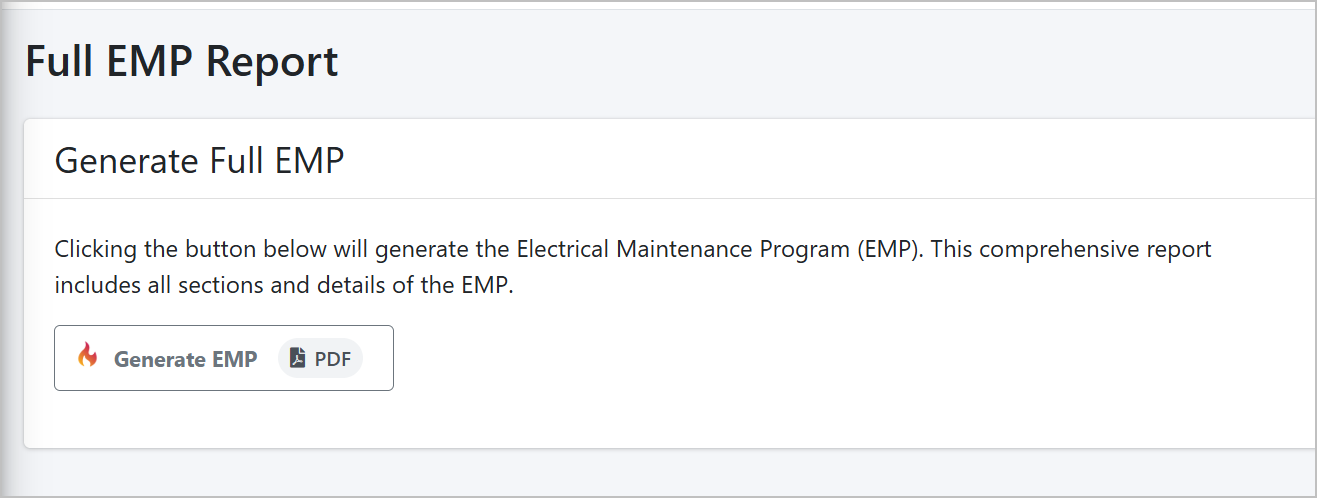
1-Click EMP Generation
Most facilities spend weeks trying to build an EMP from scratch. Consultants, spreadsheets, back-and-forth with inspectors. Gimba generates your complete, audit-ready Electrical Maintenance Program in one click. Not days. Not a consultant. One click.
Enter your assets, run your condition assessments, and the EMP is ready. Formatted to NFPA 70B standards, signed by responsible personnel, ready for an auditor or insurer on the same day you onboard.
Who Does NFPA 70B Apply To?
Any facility that owns and operates electrical distribution equipment. In practice that covers a wide range of building and facility types.
Data centers operate high-density electrical infrastructure with no tolerance for unplanned downtime. UPS systems, switchgear, PDUs, and generators all require condition assessments and documented maintenance. See our guide on NFPA 70B for data centers.
Hospitals and healthcare facilities face the highest scrutiny because electrical failures here are life-safety events. The combination of NFPA 70B, Joint Commission requirements, and NFPA 99 standards means documentation gaps have serious consequences. See NFPA 70B for hospitals.
Municipalities manage public infrastructure across water treatment, wastewater, transit, and public buildings. Each category carries its own electrical maintenance obligations under the standard.
Food and beverage manufacturers, chemical plants, and industrial facilities where production downtime is expensive and electrical incidents can trigger contamination events or significant regulatory exposure.
Electrical contractors who perform PM services for any of these facility types also have obligations. NFPA 70B defines what those services need to look like on paper, not just in the field. See NFPA 70B for electrical contractors and how to turn compliance into a recurring revenue service.
The 4 Core Requirements of NFPA 70B
A compliant NFPA 70B program has to hit four distinct areas. Miss any one of them and the program falls short of what the standard requires. See our section-by-section guide to NFPA 70B requirements.
1. Complete Asset Inventory
Every piece of electrical equipment covered by the standard has to be in your inventory. Asset name, type, location, manufacturer data, rated voltage, and a unique identifier are the baseline. Most facilities start with a one-line diagram and then walk the property to verify what is actually installed. This step usually turns up gaps: equipment added during renovations that never made it into the records, or assets that were decommissioned but never removed. See our guide to electrical asset tracking under NFPA 70B for what that inventory has to include.
2. Condition Assessments
NFPA 70B uses a 4-point condition rating scale. Every assessed asset gets a rating that drives its next maintenance interval:
Condition 1 means the equipment is in good shape. Standard intervals apply.
Condition 2 flags some degradation. Intervals shorten and the deficiency gets documented.
Condition 3 indicates significant degradation requiring corrective action. Intervals shorten further.
Nonserviceable means immediate action is required. The asset cannot be safely operated.
One key rule: the worst-rated factor on any individual assessment point sets the overall device rating. A transformer that passes every check except insulation resistance earns a Condition 3 overall. Assessments must be performed by qualified personnel. See the full guide to NFPA 70B condition assessments.
3. Maintenance Intervals by Device Type and Condition
Intervals under NFPA 70B are determined by two inputs: the device type and the current condition rating. A motor control center rated Condition 1 has a longer interval than the same MCC rated Condition 2. As condition changes, intervals adjust. This replaces the older “inspect everything annually” approach and is one of the more significant operational shifts the 2023 edition introduced. NFPA 70B Chapter 9, Table 9.3.2 provides interval guidance by device type and condition as the starting reference. Infrared thermography, for example, is required annually on all equipment – see our guide to NFPA 70B thermography requirements.
4. Documentation and the EMP
The Electrical Maintenance Program is the master document tying the program together. It covers program scope, responsible personnel, the full asset inventory with condition ratings, the maintenance schedule, and records of every maintenance activity performed. The standard specifies not just that records should exist but what those records must contain: what was assessed, when, by whom, what condition was found, and what corrective action was taken, if any. These are the records you produce when an auditor, insurer, or OSHA inspector asks for documentation.
NFPA 70B Section 4.2.4.2 – Required EMP Elements
Section 4.2.4.2 lists the 11 specific elements every EMP must include. These are binding requirements under the standard:
- Condition of maintenance assessment and its impact on electrical safety
- An electrical safety program that addresses condition of maintenance
- Identification of personnel responsible for each element of the program
- Survey and analysis of equipment to determine maintenance requirements and priorities
- Developed and documented maintenance procedures for each equipment type
- Inspection, servicing, and testing plan
- Maintenance, equipment, and personnel documentation with a records-retention policy
- Process to prescribe, implement, and document corrective measures based on collected data
- Process for incorporating design for maintainability in new installations
- Program review and revision process for continuous improvement
- Risk assessment of operational technology (OT) cybersecurity where applicable
Two additional requirements are easy to miss. Section 4.3.1 requires the equipment owner to designate a named EMP Coordinator – the individual accountable for implementing and operating the program day to day. Section 4.2.7 requires the EMP to be audited at intervals not to exceed 5 years to verify it still meets the standard. Both the coordinator designation and the audit records need to be documented and on file. For a complete guide to what belongs in that document, see Electrical Maintenance Program: What It Is and How to Build One.
How Gimba Handles This
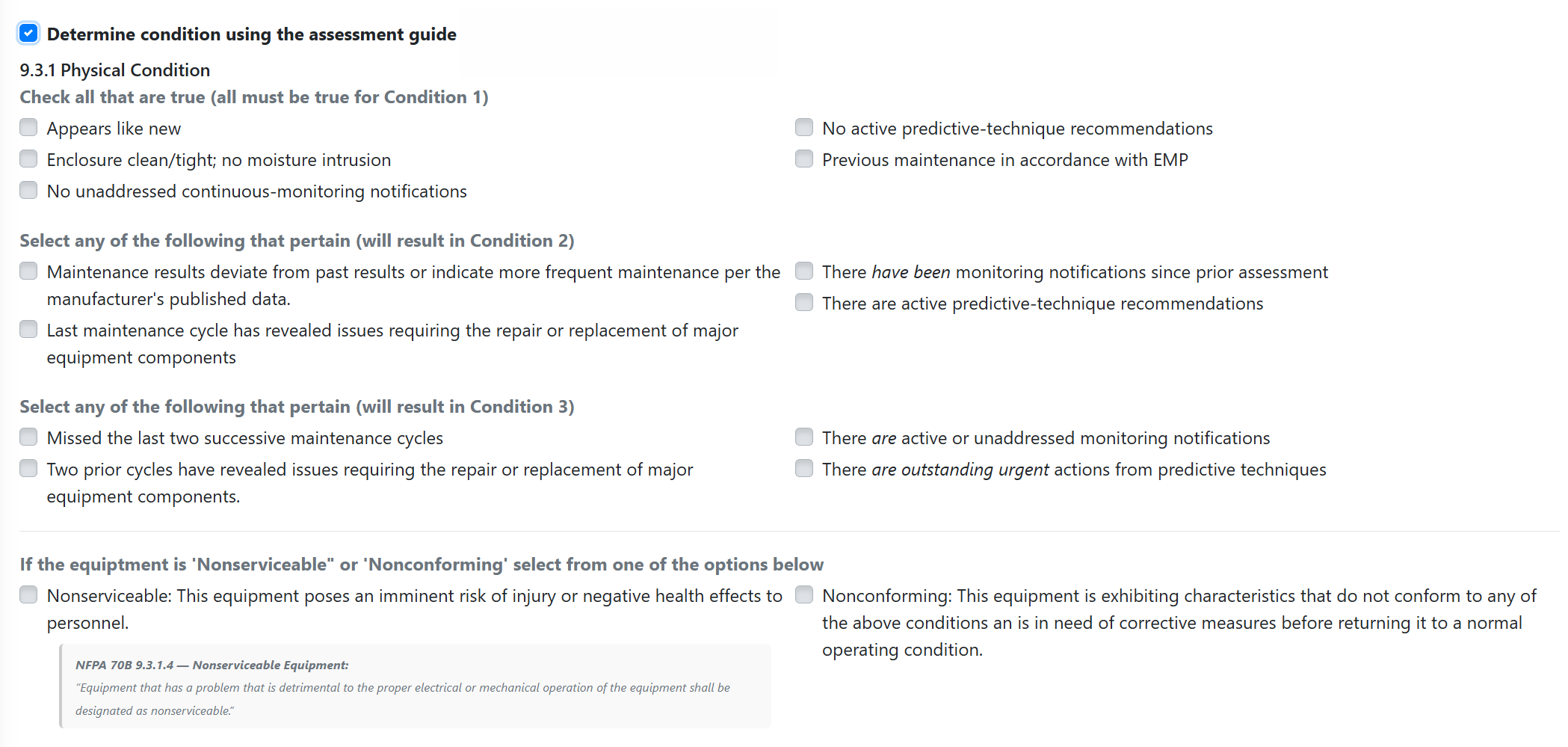
AI-Guided Condition Assessments
Your technicians do not need to be NFPA 70B experts. Gimba walks them through each condition assessment step by step, section by section, in plain language. The system applies the correct NFPA 70B criteria automatically and assigns the condition rating based on what they find.
Every assessment is logged with timestamps, findings, and the resulting condition rating. When a device drops to Condition 2 or 3, the maintenance interval adjusts automatically and the deficiency is flagged for corrective action.
How to Comply: A Practical Path
Getting compliant is a defined process, not a one-time audit event. Here is how facilities typically approach it:
Step 1: Complete your asset inventory. Walk the facility with a plan and document every covered asset. Photograph each nameplate. That data feeds your inventory and ensures the asset record matches what is actually installed.
Step 2: Conduct baseline condition assessments. Every asset needs an initial condition rating before you can set intervals and schedule maintenance. This is the most labor-intensive part of standing up the program for the first time.
Step 3: Set maintenance intervals. Use NFPA 70B Chapter 9, Table 9.3.2 as the reference for interval guidance by device type. If you are using software, this step is largely automated based on the condition ratings you just assigned.
Step 4: Build your EMP. Document the scope of the program, identify responsible personnel, formalize the schedule, and produce the written Electrical Maintenance Program.
Step 5: Execute maintenance and document as you go. Every inspection, assessment, and maintenance task needs a record. This is where most facilities without software fall apart. Spreadsheets work for a handful of assets. They break down fast when tracking dozens of assets across multiple device types.
Step 6: Review annually. NFPA 70B requires the program to be reviewed at least once per year and updated when equipment changes. Our NFPA 70B compliance checklist walks through each of these steps in detail.
How Gimba Handles This
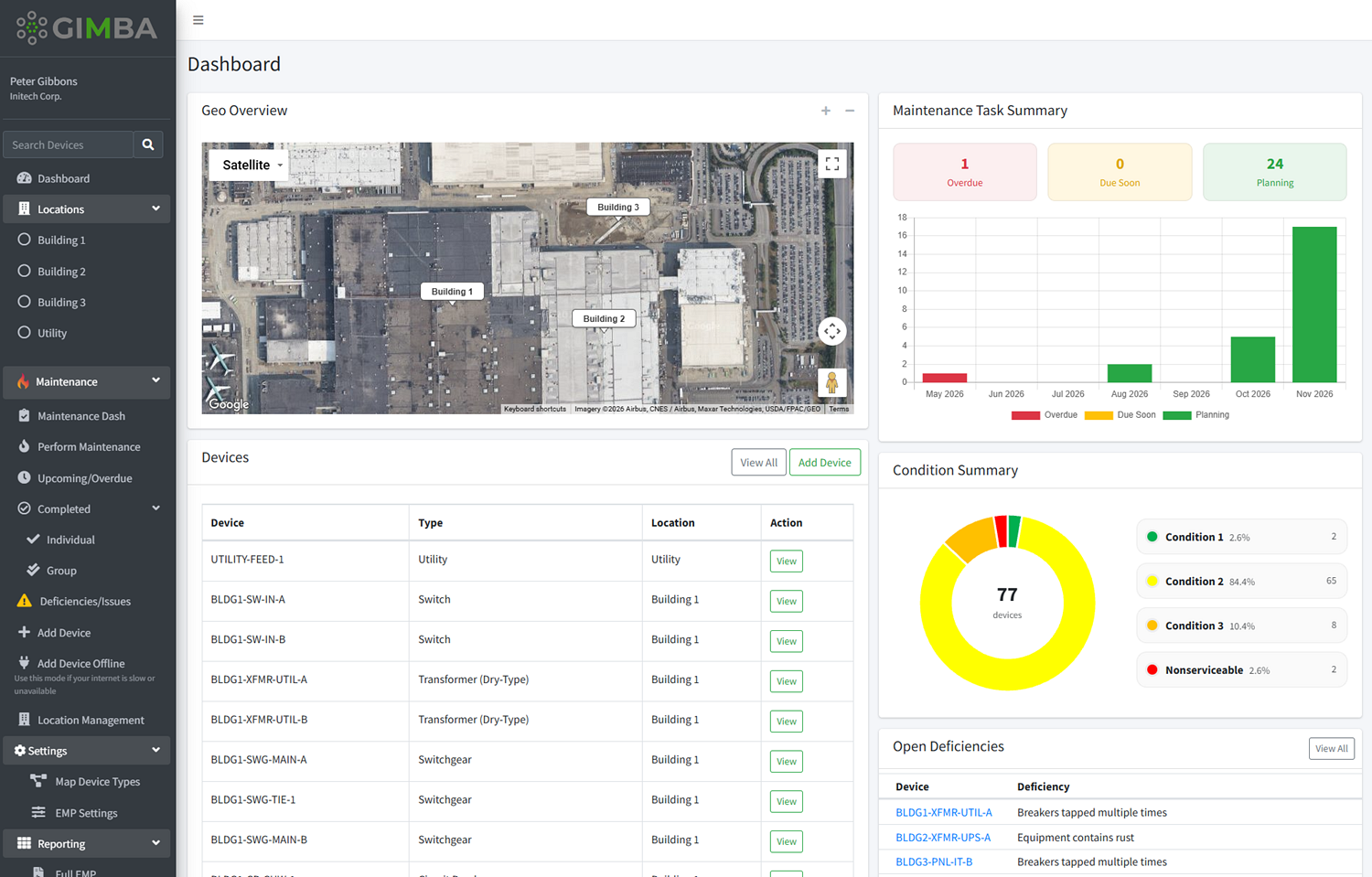
One Platform for the Full Program
Gimba handles the complete NFPA 70B workflow: asset inventory, condition assessments, maintenance scheduling, activity records, deficiency tracking, and 1-Click EMP generation. Everything in one place, at flat-rate pricing with no per-user fees.
Same-day onboarding. Most facilities have their baseline data entered and their first EMP generated on day one. The dashboard gives you live visibility across every asset at every site.
Consequences of Non-Compliance
The risks are not theoretical. Facilities without documented NFPA 70B programs face real exposure across four areas.
Insurance claim denial. An electrical incident at a facility with no maintenance records puts the carrier in a strong position to deny the claim. Insurers are increasingly auditing maintenance documentation during underwriting, and the absence of records after a fire or equipment failure can shift millions in liability.
OSHA enforcement. The general duty clause requires employers to maintain workplaces free from recognized hazards. An undocumented electrical maintenance program at a facility subject to NFPA 70B is a recognized hazard. Inspectors look for maintenance records and program documentation during incident investigations.
Liability exposure. If a person is injured or property is damaged in an electrical incident, the absence of a required maintenance program substantially increases liability. The fact that the standard was mandatory and the facility did not comply is a strong argument for negligence.
Unplanned downtime. Non-compliance increases the probability of an unexpected failure, which is often the most immediate and expensive cost. See our full article on NFPA 70B non-compliance consequences.
Ready to Build a Compliant NFPA 70B Program?
See how Gimba generates a complete, audit-ready EMP in one click. Same-day onboarding. Flat-rate pricing. No per-user fees.
Frequently Asked Questions
What equipment does NFPA 70B cover?
The standard covers electrical distribution equipment in commercial and industrial facilities: switchgear, transformers, motor control centers, panelboards, UPS systems, automatic transfer switches, generators, and related distribution components. Residential wiring is generally out of scope.
How often does electrical equipment need to be inspected?
Inspection frequency is driven by device type and condition rating, not a fixed annual calendar. A Condition 1 asset may have a 2 to 3 year interval depending on device type. A Condition 2 or 3 asset shortens that interval significantly. NFPA 70B Chapter 9, Table 9.3.2 provides the interval guidance. See our article on NFPA 70B maintenance intervals.
Do I need a consultant to comply with NFPA 70B?
Not necessarily. The standard requires qualified personnel to perform assessments, meaning people with the knowledge and experience to evaluate specific equipment types. For many facilities, qualified in-house electricians can handle routine assessments. Complex equipment like medium-voltage switchgear may warrant a third-party testing contractor for those specific assets.
What is an Electrical Maintenance Program?
An EMP is the master document defining your facility’s electrical maintenance program. It covers program scope, responsible personnel, the full asset inventory with condition ratings, the maintenance schedule, and records of maintenance performed. Under the 2023 NFPA 70B standard, a documented EMP is mandatory.
How long does it take to become NFPA 70B compliant?
The baseline inventory and condition assessment work sets the timeline. A smaller facility with fewer than 50 assets can often complete baseline assessments in a day or two. Larger facilities with hundreds of assets may take several weeks for the full baseline pass. Once baseline is complete, ongoing compliance is staying current with scheduled maintenance and keeping records updated. With Gimba, most clients have their first EMP generated on the same day they onboard.
What is the difference between NFPA 70B and NFPA 70E?
NFPA 70B covers electrical equipment maintenance: the inspection, testing, and documentation program for your electrical distribution system. NFPA 70E covers electrical safety in the workplace: arc flash hazard analysis, PPE requirements, and safe work practices for energized electrical work. They address different aspects of electrical risk management and both apply to most commercial and industrial facilities. See our full comparison of NFPA 70B vs NFPA 70E.
Related reading: What Is NFPA 70B? | Compliance Checklist | Non-Compliance Consequences | NFPA 70B vs 70E | EMP Explained | NFPA 70B Software
