

NFPA 70B SOFTWARE
The Best Maintenance Management Software for NFPA 70B Compliance
General CMMS tools track work orders. NFPA 70B compliance requires something more specific. Here is what actually matters.
What General CMMS Tools Do Well
A standard CMMS handles work orders, preventive maintenance scheduling, and asset tracking. For facilities with general maintenance needs across HVAC, plumbing, and mechanical systems, that coverage is enough.
Most of the well-known platforms in this space were built for broad facility management. They are horizontal tools. A hospital using one of these systems can track a boiler service the same way it tracks a door hinge replacement. That flexibility is useful in a lot of contexts.
The problem shows up the moment a facility needs to demonstrate NFPA 70B compliance. General CMMS tools have no concept of an Electrical Maintenance Program. They do not know what Chapter 9 maintenance intervals are. They cannot generate an audit-ready EMP. They were not built for it.
What NFPA 70B Actually Requires from Software
NFPA 70B compliance is built around a few specific outputs. A documented Electrical Maintenance Program. Condition assessments for every piece of electrical equipment in scope. Maintenance schedules tied to Chapter 9 intervals and manufacturer recommendations. Records of what was done, when, by whom, and what was found.
A general work order tool can log that a technician serviced a switchgear panel on a given date. It cannot tell you whether that service met NFPA 70B requirements. It cannot generate the EMP section that documents your inspection procedures. It has no structured condition assessment workflow that walks a technician through the 70B-specific checks.
The gap matters most during an audit or incident investigation. An OSHA inspector or insurance adjuster will not accept a work order log as proof of a compliant maintenance program. They want the EMP. They want the condition assessment records. A general CMMS cannot produce those documents because it was never designed to capture the underlying data.
Features That Actually Matter for Electrical Compliance
When evaluating NFPA 70B software, the features that matter for compliance are different from standard CMMS selling points. Here is what to look for.
EMP generation. The software should produce a complete Electrical Maintenance Program document, not a template. The EMP should be built from your actual equipment data, not a fill-in-the-blank form.
Structured condition assessments. The assessment workflow needs to follow the NFPA 70B framework, section by section. Technicians should be guided through the process rather than left to interpret the standard themselves. Photo capture tied to equipment records is table stakes.
Chapter 9 interval alignment. Maintenance schedules should map to NFPA 70B maintenance intervals by equipment type, not just calendar-based reminders. The system should know that a dry-type transformer has different requirements than a liquid-filled transformer.
Audit-ready reporting. When an inspector or insurer asks for documentation, you should be able to pull it immediately. Not assemble it from spreadsheets. Not reconstruct it from email threads. One click, complete package.
Asset nameplate capture. Equipment data entry is where most programs stall. A system that lets technicians photograph nameplates and auto-populate asset records removes the bottleneck that keeps facilities from ever finishing their asset inventory.
How Gimba Handles This
Built for NFPA 70B. Not Adapted for It.
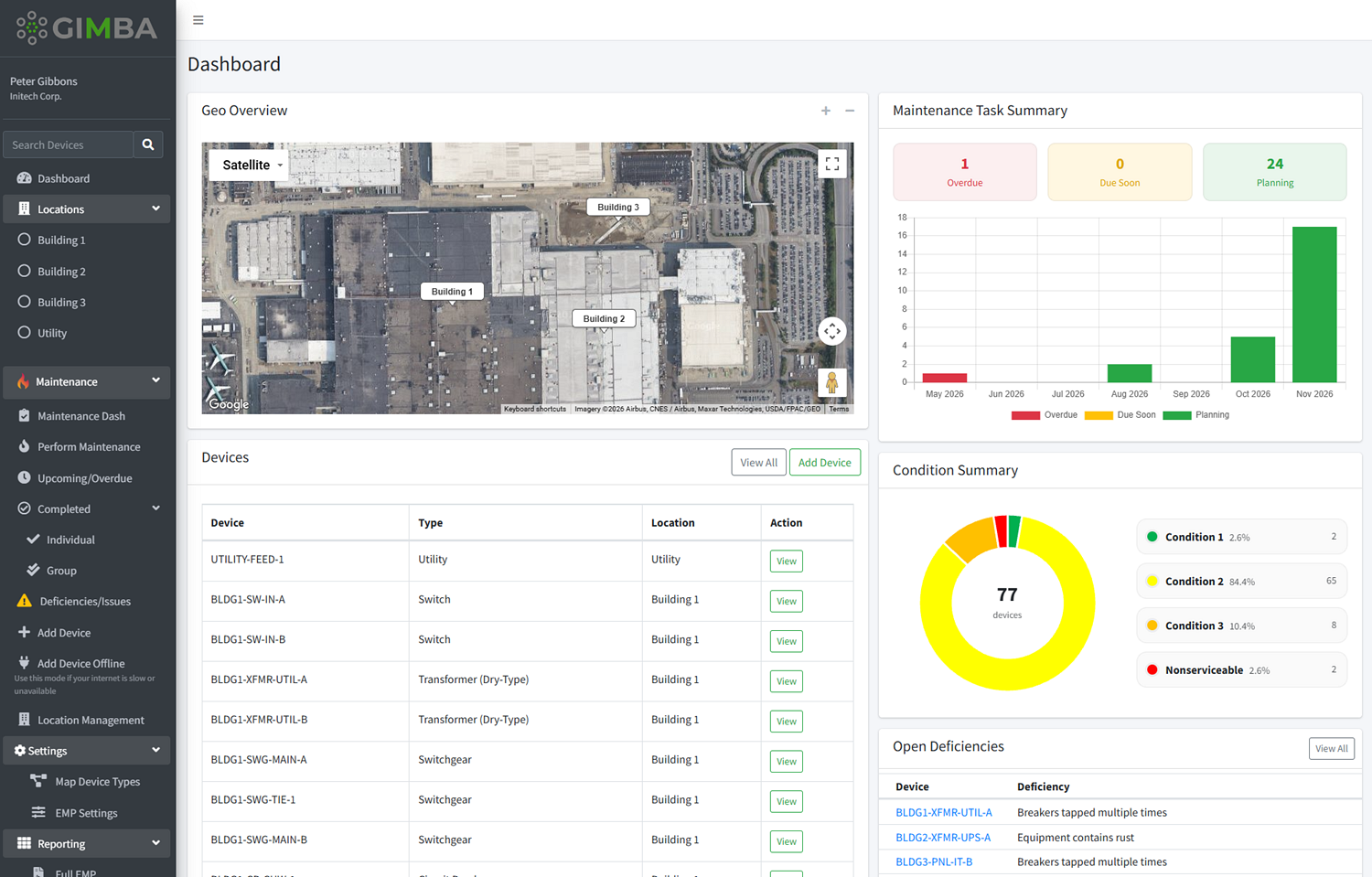
Gimba was designed specifically for NFPA 70B electrical maintenance compliance. Not a general CMMS with a compliance module bolted on. Every feature in the platform exists to support one outcome: a facility that can prove it has an active, compliant electrical maintenance program.
1-Click EMP generation. AI-guided condition assessments. Chapter 9 maintenance interval scheduling. Audit-ready reports on demand. Flat-rate pricing with no per-user fees. See a demo.
Electrical contractors can also white-label the platform and offer NFPA 70B compliance as a recurring annual service to their clients.
Why Purpose-Built Beats General-Purpose for Compliance
The argument for using a general CMMS is usually cost or existing deployment. The facility already has UpKeep or Fiix running for other maintenance categories, and adding a separate system feels like overhead.
That logic breaks down when compliance is the actual goal. A general tool can track that electrical maintenance happened. It cannot prove that maintenance met NFPA 70B requirements. When an insurer denies a claim or an OSHA inspector cites a General Duty Clause violation, the work order log from a general CMMS is not the documentation they are looking for.
The cost of non-compliance runs higher than the cost of purpose-built software. A single denied insurance claim or OSHA citation will exceed years of flat-rate Gimba pricing. The question is not whether you can afford purpose-built software. It is whether you can afford the gap that a general tool leaves.
How to Evaluate Your Options
The shortest test for any maintenance management software you are evaluating: ask it to generate a complete NFPA 70B Electrical Maintenance Program for your facility. If the answer involves a consultant, a template, or significant configuration time, you are looking at a workaround, not a solution.
A purpose-built platform should handle the full compliance workflow out of the box. EMP generation, guided condition assessments, maintenance scheduling, deficiency tracking, and audit-ready reporting. If any of those require external tools or manual assembly, the software is not built for your actual requirement.
Pricing structure matters too. Per-user fees create friction for facilities with field technicians doing inspections. A flat-rate model that covers unlimited users keeps the cost predictable and does not penalize you for doing compliance correctly.
See What Purpose-Built Looks Like
Gimba is the only platform built specifically for NFPA 70B electrical maintenance compliance. Same-day onboarding. Flat-rate pricing. No consultants required.
Frequently Asked Questions
Can a general CMMS be used for NFPA 70B compliance?
A general CMMS can track that electrical maintenance occurred. It cannot generate an Electrical Maintenance Program, structure condition assessments per NFPA 70B requirements, or produce audit-ready compliance documentation. For a facility that needs to demonstrate 70B compliance, a general CMMS is the wrong tool.
What is the difference between CMMS software and NFPA 70B compliance software?
CMMS software manages maintenance workflows broadly. NFPA 70B compliance software is built around a specific regulatory outcome: a documented, auditable electrical maintenance program that meets the requirements of the standard. The features, data structures, and outputs are fundamentally different.
How much does NFPA 70B compliance software cost?
Gimba uses flat-rate pricing with no per-user fees. The cost is less than a single consultant visit. Pricing details are available on a demo call. The more relevant comparison is the cost of non-compliance: a denied insurance claim or OSHA citation will run multiples of annual software cost.
Can electrical contractors use this software for their clients?
Yes. Gimba offers a white-label version for electrical contractors who want to offer NFPA 70B compliance as a recurring annual service. Contractors can brand the platform as their own and manage multiple client facilities from a single account.
How quickly can a facility get up and running?
Same-day onboarding. Most facilities have their equipment entered and their first EMP generated within a day of starting. There is no lengthy implementation or consultant engagement required to get the system live.
Related reading: NFPA 70B Overview | How to Comply with NFPA 70B | EMP Requirements | Schedule a Demo
