Data centers have some of the most complex electrical infrastructure of any facility type. They also have some of the most specific compliance gaps. Redundant power paths, high-density UPS systems, 24/7 uptime obligations – these create NFPA 70B challenges that a standard industrial checklist doesn’t account for.
This covers what NFPA 70B requires for data center facilities, which equipment types need the most attention, how it intersects with Uptime Institute Tier requirements, and how to build an Electrical Maintenance Program that actually works in a live environment.
Why Data Centers Face Unique NFPA 70B Challenges
Most NFPA 70B guidance was developed with industrial facilities and commercial buildings in mind. Data centers share the same core requirements but face operational realities that complicate implementation:
- No planned downtime windows: many circuits cannot be de-energized for maintenance without impacting critical tenants or SLA commitments
- Redundant power paths: A/B feeds, dual-bus configurations, and static transfer switches create complex dependency relationships where a maintenance error on one path can cascade unexpectedly
- High asset counts: the number of assets requiring condition assessments (PDUs, UPS modules, breakers, transfer switches) can number in the thousands for a large facility
- Tenant complexity: in co-location environments, equipment ownership is split, and NFPA 70B compliance responsibility must be clearly defined across the demarcation
- SLA obligations: contractual uptime commitments mean any maintenance-related outage is simultaneously an operational and a legal event
How Gimba Handles This
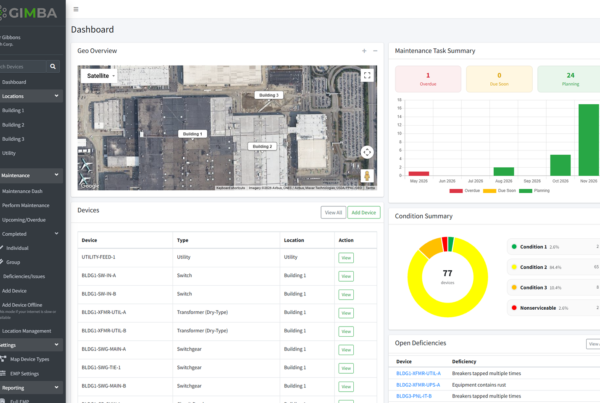
Gimba gives data center operators full visibility across the entire distribution system, asset by asset or as a one-line diagram, across all sites. A large data center with thousands of PDUs, breakers, UPS modules, and transfer switches has every asset tracked, condition-rated, and on a maintenance schedule. You can see the full electrical footprint at a glance and drill down to any individual device. Nothing falls through the cracks because there is no manual tracking to fall through.
Critical Equipment Categories
UPS Systems
Uninterruptible power supply systems are among the most maintenance-intensive assets in a data center. Battery systems require regular testing, capacity assessments, and cell replacement based on condition rather than a fixed calendar schedule, which aligns well with NFPA 70B’s condition-based framework, though the documentation requirements go further than most manufacturers’ programs alone.
Battery condition assessments must evaluate internal resistance, capacity test results, electrolyte levels (for flooded cells), physical condition of terminals and cells, and operating temperature. Elevated temperatures in the battery room or cabinet accelerate degradation dramatically and are a factor frequently underweighted in informal maintenance programs.
How Gimba Handles This
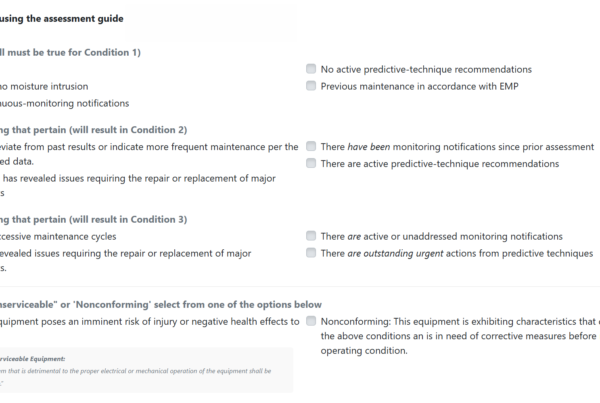
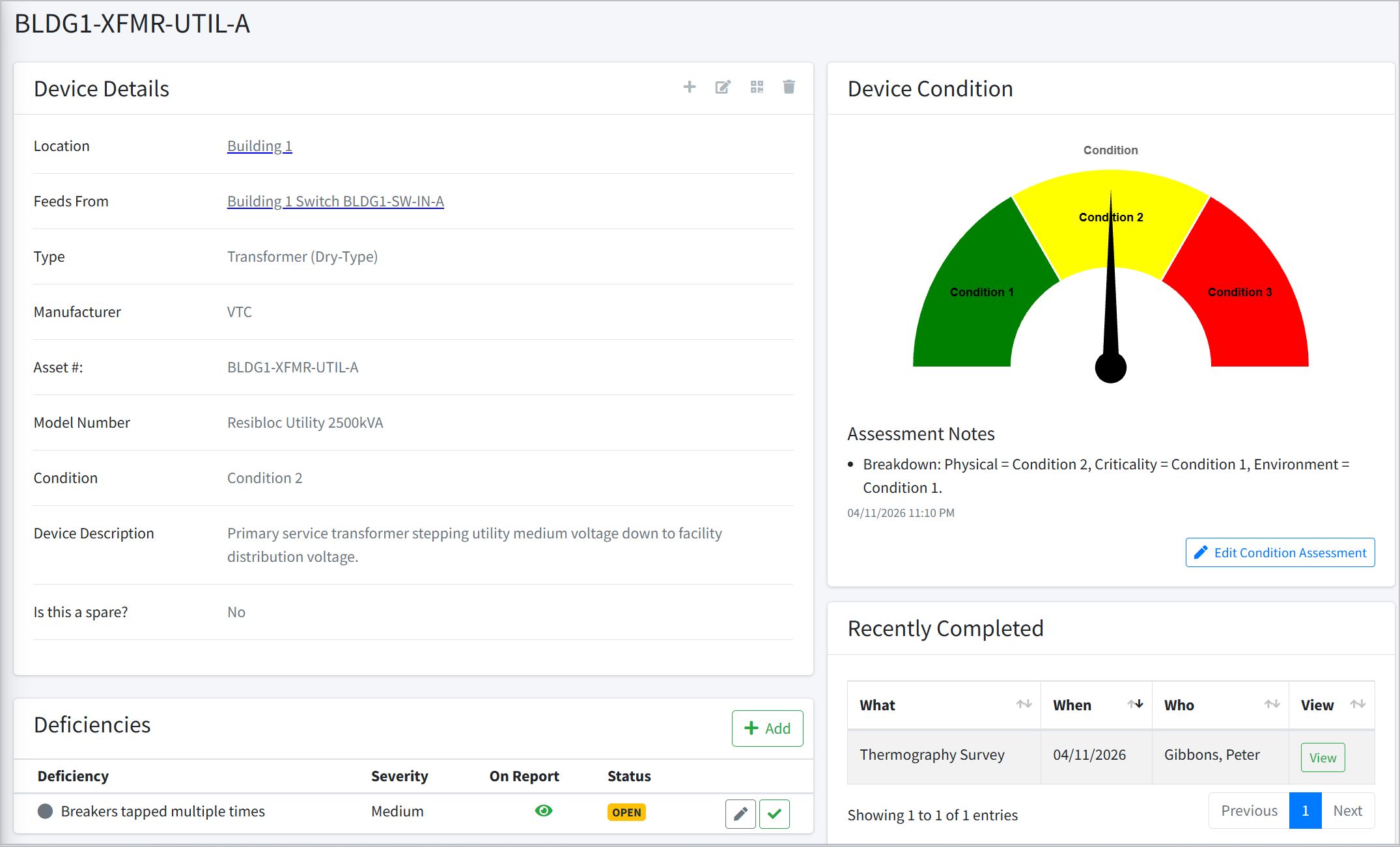
Gimba tracks condition assessments for each UPS component, including individual battery strings. When a battery system is assessed and rated Condition 2, the system automatically shortens the next assessment interval and flags the asset for corrective action, based on NFPA 70B intervals for that device type. Maintenance is driven by actual condition rather than a generic calendar, which is exactly what the standard requires and what your insurer expects to see documented.
Switchgear and Metal-Clad Switchgear
Medium and high-voltage switchgear is where data center NFPA 70B compliance gets most complex. These assets are often in confined spaces, may be difficult to de-energize, and contain components (breaker mechanisms, protective relays, bus insulation) that require hands-on testing to assess properly.
Condition assessments must address contact resistance, insulation resistance, mechanical operation of breaker mechanisms, the condition of arc chutes, and thermographic findings from the energized inspection. Protective relay testing adds another layer of required documentation.
Transformers
Distribution transformers feeding data center loads require condition assessment under NFPA 70B. For oil-filled units, dissolved gas analysis (DGA) is the most sensitive early-warning indicator of developing faults invisible to external inspection. For dry-type transformers, the focus shifts to winding insulation condition, thermographic inspection, and the integrity of cooling systems.
If you have oil-filled transformers and aren’t running dissolved gas analysis, that’s a significant NFPA 70B gap and a reliability risk that visual inspection alone won’t catch until something has already failed.
Transfer Switches
Static transfer switches and automatic transfer switches are operationally critical: they are what stands between a utility failure and a load outage. Condition assessments must address transfer time testing, contact condition, control circuitry function, and the integrity of the bypass path. Given their criticality, these assets often warrant the most conservative condition ratings and intervals.
Emergency Generators
Generators powering data center critical loads require maintenance under both NFPA 70B and NFPA 110. For NFPA 70B compliance, generator condition assessments address the electrical distribution components, including output breakers, paralleling switchgear, and automatic transfer equipment, along with documented load bank testing results.
Power Distribution Units and Bus Ducts
Floor-level PDUs, overhead bus ducts, and the breakers within them represent a large share of total asset count in a data center. While individual units may seem low-risk, their cumulative importance in the distribution path makes documenting condition important. Thermographic inspection during normal operation is particularly effective for identifying developing hot spots without requiring de-energization.
NFPA 70B and Uptime Institute Tier Standards
Data center operators pursuing or maintaining Uptime Institute Tier certification often ask how NFPA 70B relates to Tier requirements. The short answer: they address different things but complement each other well.
Tier standards establish infrastructure redundancy and concurrent maintainability requirements. They do not prescribe specific maintenance programs. NFPA 70B fills that gap: it defines what the maintenance program for Tier-compliant infrastructure must look like. A Tier III or IV facility without a documented, compliant EMP has invested heavily in the infrastructure to survive failures but may not be performing the maintenance that prevents them.
In Uptime Institute Tier certification audit reviews, maintenance documentation deficiencies are a common finding. NFPA 70B compliance directly strengthens Tier audit outcomes.
How NFPA 70B Affects Data Center Insurance
Property and business interruption insurance for data centers is expensive and increasingly tied to maintenance documentation. Underwriters at major insurers routinely request evidence of a formal electrical maintenance program during applications and renewals.
A well-documented, NFPA 70B-compliant program demonstrates active electrical risk management, which translates to more favorable terms. Without documentation, facilities face higher premiums and the claim denial risk that follows any electrical event where maintenance records cannot be produced.
Building an EMP That Works for a 24/7 Facility
The practical challenge is execution: how do you complete condition assessments and maintenance on equipment that can rarely be taken offline?
- Redundancy-based maintenance windows: use the redundant paths your Tier design provides. Transfer load to the B-feed, take the A-feed offline for full testing, then reverse. Requires coordination but enables complete de-energized assessment.
- Live monitoring and diagnostics: continuous monitoring systems (power quality analyzers, battery monitors, temperature sensors) can substitute for some periodic testing and provide ongoing condition data between formal assessments.
- Thermographic inspection during operation: a large portion of condition assessment can be completed with equipment energized, using infrared thermography to identify developing faults.
- Phased assessment programs: for large facilities, conducting assessments by system, floor, or distribution path makes the program manageable without requiring simultaneous access to everything.
How Gimba Handles This
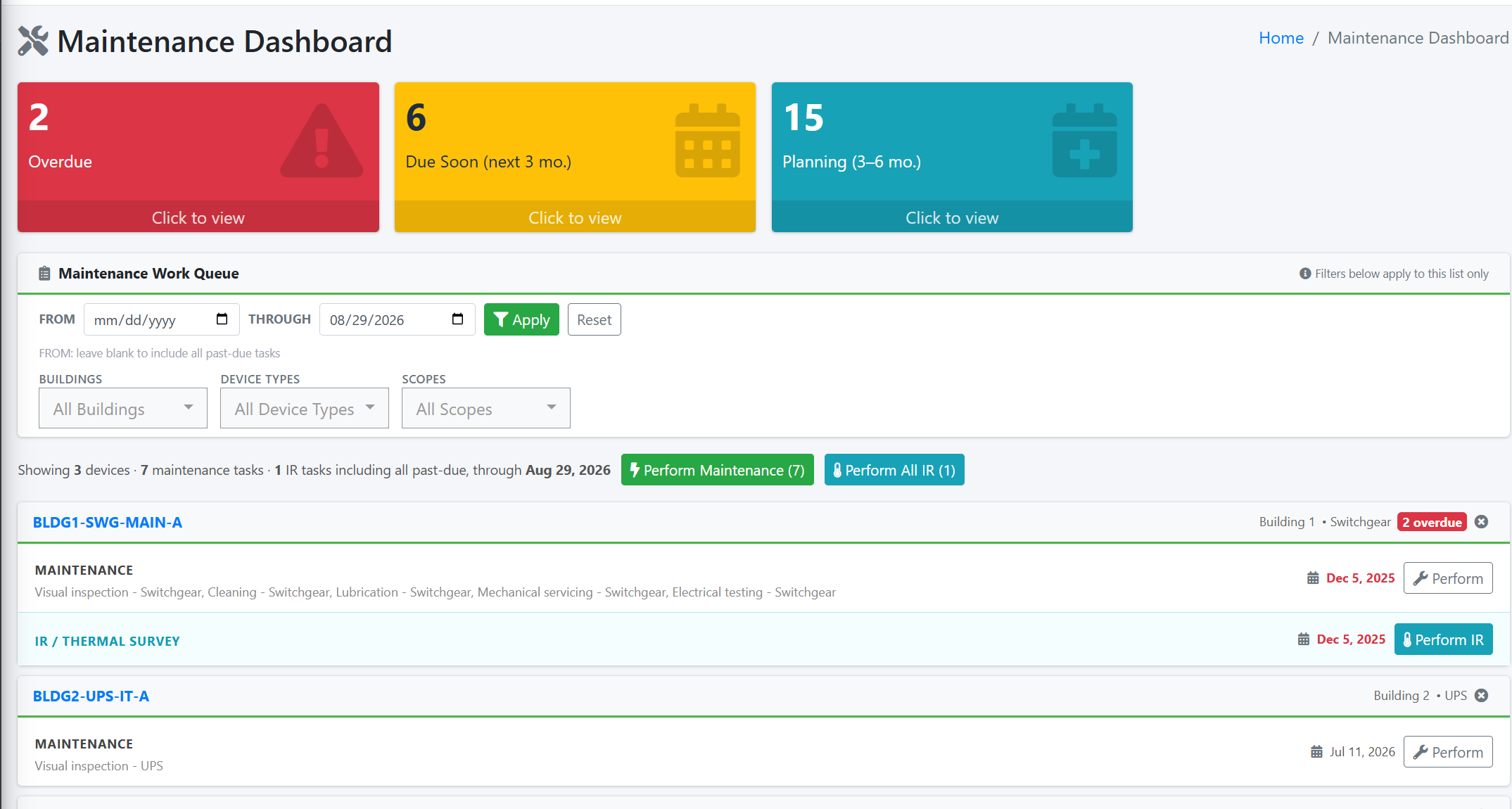
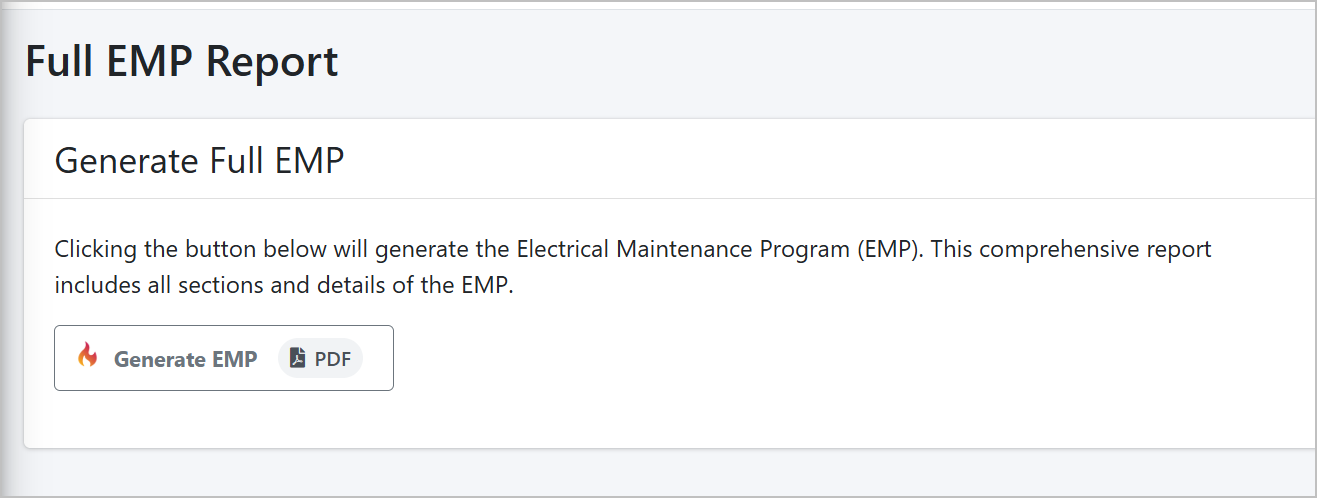
The EMP challenge is real for data center operators: coordinating dozens of asset types, multiple power paths, and often multiple ownership boundaries into a single compliant document. Gimba generates your complete EMP in one click, pulling current condition data, maintenance records, and full asset inventory into a formatted, audit-ready document. Facilities that used to spend weeks assembling their EMP produce it in minutes. And because all the underlying data is current in Gimba, the document reflects the actual state of your program, not a snapshot from the last time someone updated a spreadsheet.
Built for Complex Electrical Environments
Gimba handles the full scope of NFPA 70B compliance: condition assessments across thousands of assets, maintenance scheduling by device type and condition rating, and one-click EMP generation that satisfies insurers, Tier auditors, and AHJs.
Frequently Asked Questions
Does NFPA 70B apply to co-location data centers?
Yes. Co-location operators are responsible for NFPA 70B compliance for the infrastructure they own and operate. Tenants may have maintenance responsibilities for equipment they own beyond the demarcation point. Clear documentation of ownership boundaries is important for defining each party’s compliance scope.
Our third-party maintenance provider handles all electrical work. Does that satisfy NFPA 70B?
Using a qualified third-party provider can satisfy the maintenance activity requirements, but the documentation responsibility remains with the facility operator. Your EMP must capture and record work performed by contractors, and overall program accountability stays with the operator.
How do we manage NFPA 70B compliance across multiple data center sites?
Multi-site compliance is exactly where purpose-built software delivers the most value. Managing condition assessments, maintenance intervals, and EMP documentation across five or ten facilities in spreadsheets is unworkable. NFPA 70B compliance software with a multi-facility dashboard keeps all sites visible and compliant from a single platform.
How does NFPA 70B relate to NFPA 70E for data center workers?
NFPA 70B covers the equipment maintenance program. NFPA 70E covers how workers are protected while performing electrical tasks. Both apply in data centers. See our NFPA 70B vs NFPA 70E guide for a full breakdown.
Related reading: NFPA 70B Overview | Condition Assessment Guide | Consequences of Non-Compliance | NFPA 70B Compliance Software