Work began on the 2026 revision of NFPA 70B almost immediately after the landmark 2023 edition was published. With nearly 4,000 public inputs submitted to the revision cycle (an extraordinary level of industry engagement), the electrical maintenance community has made clear that the conversation is far from over.
For facility managers and compliance teams already working to implement the 2023 requirements, tracking what is coming matters. Changes to condition assessment criteria, maintenance intervals, or documentation requirements can reshape your Electrical Maintenance Program significantly. Here is where things stand.
Where We Stand: The 2023 Edition Changed Everything
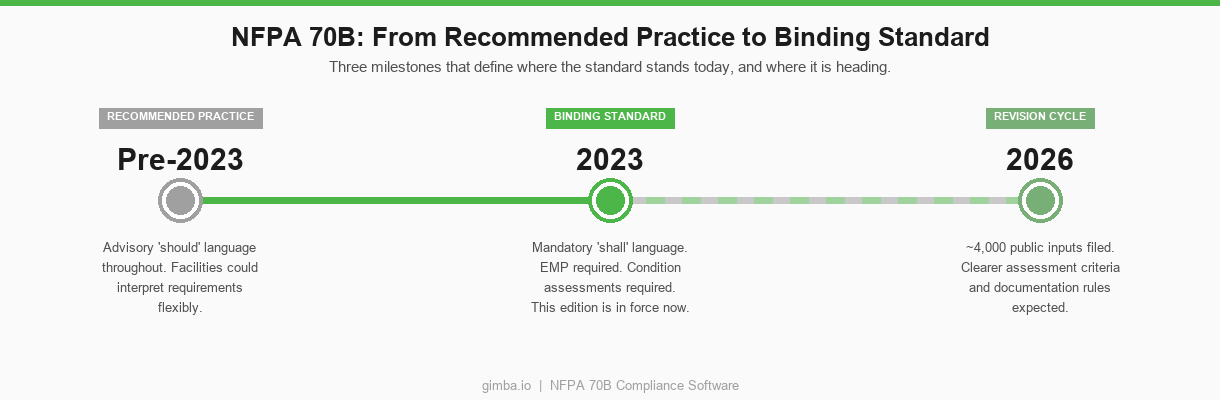
The previous edition of NFPA 70B was titled Recommended Practice for Electrical Equipment Maintenance. The 2023 edition dropped that title entirely, becoming simply the Standard for Electrical Equipment Maintenance, and converted advisory language to mandatory requirements throughout.
That shift had immediate, practical consequences. Requirements that were previously advisory became binding. Insurance companies and regulators adjusted their expectations accordingly. Facilities that had treated NFPA 70B as a reference document found themselves subject to a standard with real enforcement consequences.
The 2026 revision builds on that foundation. The volume of public inputs suggests the industry wants clarification on areas where the 2023 text left room for interpretation, particularly around condition assessment criteria, maintenance intervals, and documentation standards.
Key Areas Being Addressed in the 2026 Revision
Equipment Condition Assessment Criteria
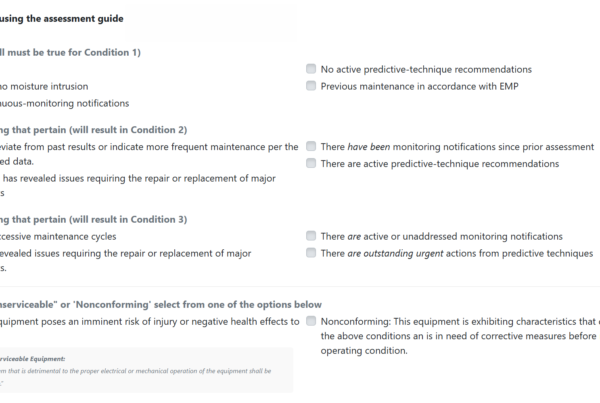
The Equipment Condition Assessment (ECA) framework (with its four ratings from Condition 1 through Nonserviceable) has been widely praised as the right approach but criticized for leaving too much to interpretation in specific equipment categories. Proposed revisions aim to provide more defined criteria for common types, including switchgear, transformers, and motor control centers.
More consistent criteria means less variability between assessors evaluating the same equipment, which strengthens the defensibility of your program when it is reviewed by an insurer or auditor.
System Studies Requirements
Chapter 6 of the 2023 standard requires system studies (short-circuit analysis, coordination studies, and arc flash incident energy analysis) on a maximum five-year cycle. Proposals for 2026 explore whether certain equipment changes should trigger an interim study requirement rather than waiting for the next scheduled cycle. This has direct implications for single-line diagram management between study cycles.
Documentation Standards
One consistent piece of feedback from the 2023 implementation cycle has been a desire for clearer guidance on what ‘documented’ means in practice. Proposals under consideration would define minimum documentation requirements more precisely, including what must be captured in condition assessment records and what constitutes adequate evidence of program compliance.
How Gimba Handles This
If your program is managed in Gimba, stricter documentation standards are not a rework project. Gimba already captures condition assessment results, assessor information, test findings, and resulting maintenance intervals for every asset. When the 2026 standard defines documentation minimums more precisely, facilities with software-managed programs will already meet them. There is nothing to manually reconstruct.

Testing Methods and Intervals
Proposals address specific testing methods and intervals for high-voltage equipment rated above 1,000V. Requirements for insulation resistance testing, infrared thermography, and power factor testing are expected to be clarified, with more direct linkage between test frequency and condition ratings.
The Best Preparation for 2026 Is Getting 2023 Right
The proposed 2026 changes are refinements, not a rewrite. Facilities that are genuinely compliant with 2023 won’t need to start over. The question is whether you actually have all the pieces in place right now.
A complete asset inventory. Current condition assessments across all your electrical equipment. Maintenance intervals that flow from those assessments. A written, up-to-date Electrical Maintenance Program. System studies within the five-year window. Full maintenance records you can actually pull on demand. That’s the baseline – and it’s what 2026 will build on.
How Gimba Handles This
Gimba gives you every item on that checklist in one platform. Complete asset inventory, condition assessments that automatically drive maintenance intervals by device type per NFPA 70B frequencies, a maintenance schedule that updates as assessments are completed, and one-click EMP generation. The checklist above is not a series of separate projects to manage. In Gimba, it is a starting screen.
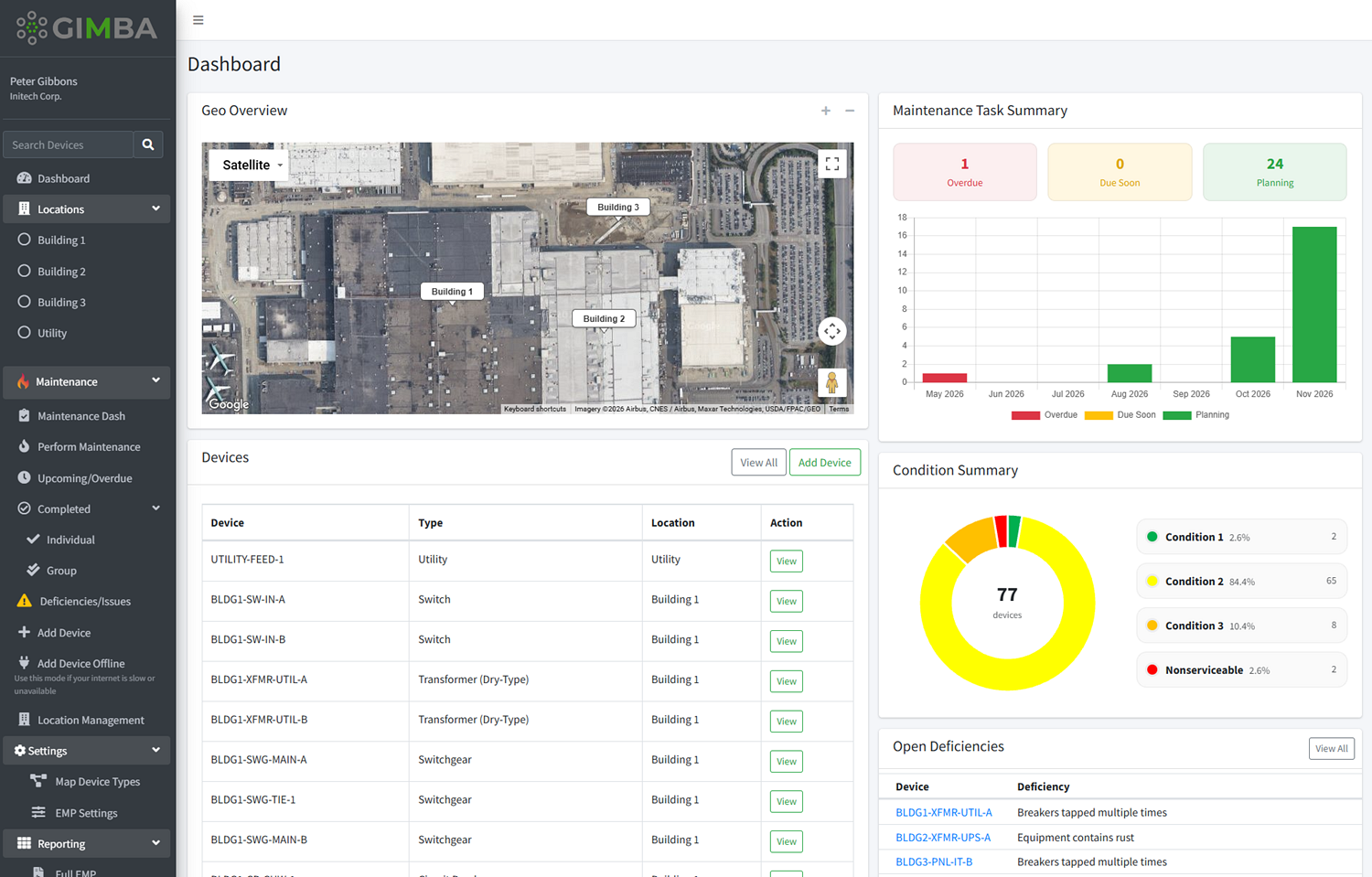
Software-managed programs have a clear advantage when standards change: updating your program means adjusting criteria in the system, not manually reworking hundreds of records. Purpose-built compliance software makes adapting to regulatory updates far more manageable.
Don’t Wait for 2026, Get Compliant Now
Get your NFPA 70B program in place today. Gimba generates a complete, audit-ready EMP in one click and adapts as requirements evolve.
Frequently Asked Questions
When will the NFPA 70B 2026 edition be finalized?
NFPA standards follow a defined development process including public input, committee review, and public comment periods before adoption. Check the official NFPA 70B development page for current timeline information.
Will facilities need to revise their EMP when 2026 is published?
Likely yes, to some degree, though the extent depends on the final changes adopted. Software-managed programs can incorporate updates far more efficiently than manually maintained records.
Is it worth implementing NFPA 70B 2023 now if 2026 will change things?
Absolutely. Getting compliant with 2023 now delivers real protection. OSHA electrical safety standards reference NFPA 70B as the benchmark – insurance, legal liability that non-compliance puts at risk today. The 2026 refinements will not require starting over.
Related reading: NFPA 70B Overview | Building Your EMP | Consequences of Non-Compliance