

NFPA 70B COMPLIANCE GUIDE
How to Create an Electrical Maintenance Program
NFPA 70B now requires a documented Electrical Maintenance Program at every commercial and industrial facility. Here is what a compliant EMP actually contains, section by section, and how to build one.
What NFPA 70B Actually Requires
The 2023 edition of NFPA 70B shifted the standard from recommended practice to mandatory. Section 4.2 uses “shall” throughout, which under NFPA definitions indicates a binding requirement. Facilities without a documented Electrical Maintenance Program are not in compliance.
What surprises most facilities is the scope. An EMP isn’t a checklist or an annual maintenance log. It’s a structured program document that defines your entire approach to electrical maintenance: what equipment you have, what condition it’s in, who’s responsible for it, when it gets serviced, and how you record and act on that data.
It also gets audited. Section 4.2.7 of the standard requires the EMP to be reviewed at intervals not exceeding 5 years to verify it still meets requirements. That audit needs to be documented and on file.
If you want to read the full standard before building your program, our NFPA 70B PDF downloads page has access to the document and supporting materials. Or start with the free NFPA 70B compliance spreadsheet to get a sense of what needs to be tracked before committing to software.
The 11 Required Elements of a Compliant EMP
Section 4.2.4.2 of NFPA 70B lists exactly what your EMP must contain. These aren’t suggestions. Every item below is a “shall” requirement under the standard:
NFPA 70B Section 4.2.4.2 – Required EMP Elements
- Condition of maintenance assessment and its impact on electrical safety
- An electrical safety program that addresses condition of maintenance
- Identification of personnel responsible for each element of the program
- Survey and analysis of equipment to determine maintenance requirements and priorities
- Developed and documented maintenance procedures for each equipment type
- Inspection, servicing, and testing plan
- Maintenance, equipment, and personnel documentation with a records-retention policy
- Process to prescribe, implement, and document corrective measures based on collected data
- Process for incorporating design for maintainability in new installations
- Program review and revision process for continuous improvement
- Risk assessment of operational technology (OT) cybersecurity where applicable
Section 4.3.1 adds one more: a named EMP Coordinator must be identified as the individual accountable for day-to-day program operation. Without a named coordinator with documented responsibilities, the program fails that section. See our full EMP requirements breakdown for more detail on each element.
How Gimba Handles This
All 11 Elements. One Click.
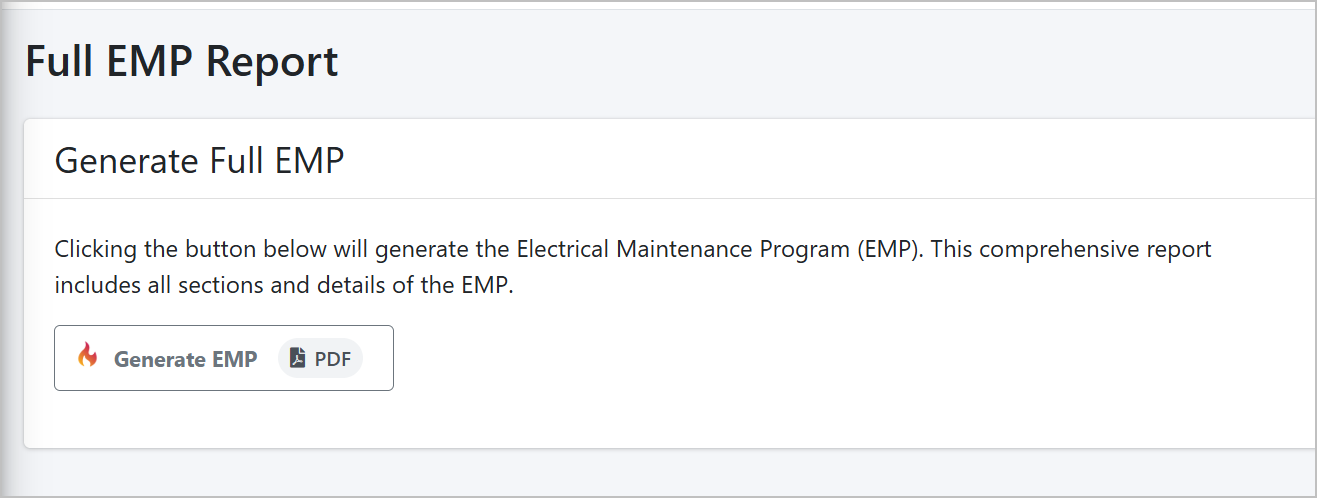
When your equipment data is in Gimba, the platform generates a complete, formatted EMP document that satisfies every element in Section 4.2.4.2. Not days. Not a consultant. One click.
The EMP output has been reviewed positively by electrical industry experts familiar with the NFPA 70B standard, including feedback from members of the NFPA 70B technical committee. It’s formatted for auditors, insurers, and the AHJ from the moment it generates.
See the full Gimba feature set or schedule a demo to see it generated live.
Building the EMP: Step by Step
The five steps below map directly to the NFPA 70B required elements. Each one feeds the next. Get through all five and you have everything needed to generate a compliant EMP.
NFPA 70B doesn’t prescribe a specific document format, only what the program must contain. The document needs to be written, current, and accessible to auditors on demand. The standard also requires it be kept up to date as equipment or personnel changes.
Step 1
Build Your Equipment Inventory
Every piece of electrical distribution equipment needs to be documented. Switchgear, transformers, motor control centers, panelboards, automatic transfer switches, generators, UPS systems, and related distribution equipment are all in scope. Residential wiring is generally not.
For each asset, capture: manufacturer, model, voltage rating, installation date or estimated age, location in the facility, and a unique asset ID. This inventory becomes the backbone of the entire program. Maintenance intervals, condition assessments, and the EMP document all reference it.
Facilities with a few dozen devices can start from a spreadsheet. Larger sites or multi-facility operations typically need a dedicated system. The free NFPA 70B compliance spreadsheet is a useful starting point before committing to software.
How Gimba Handles This
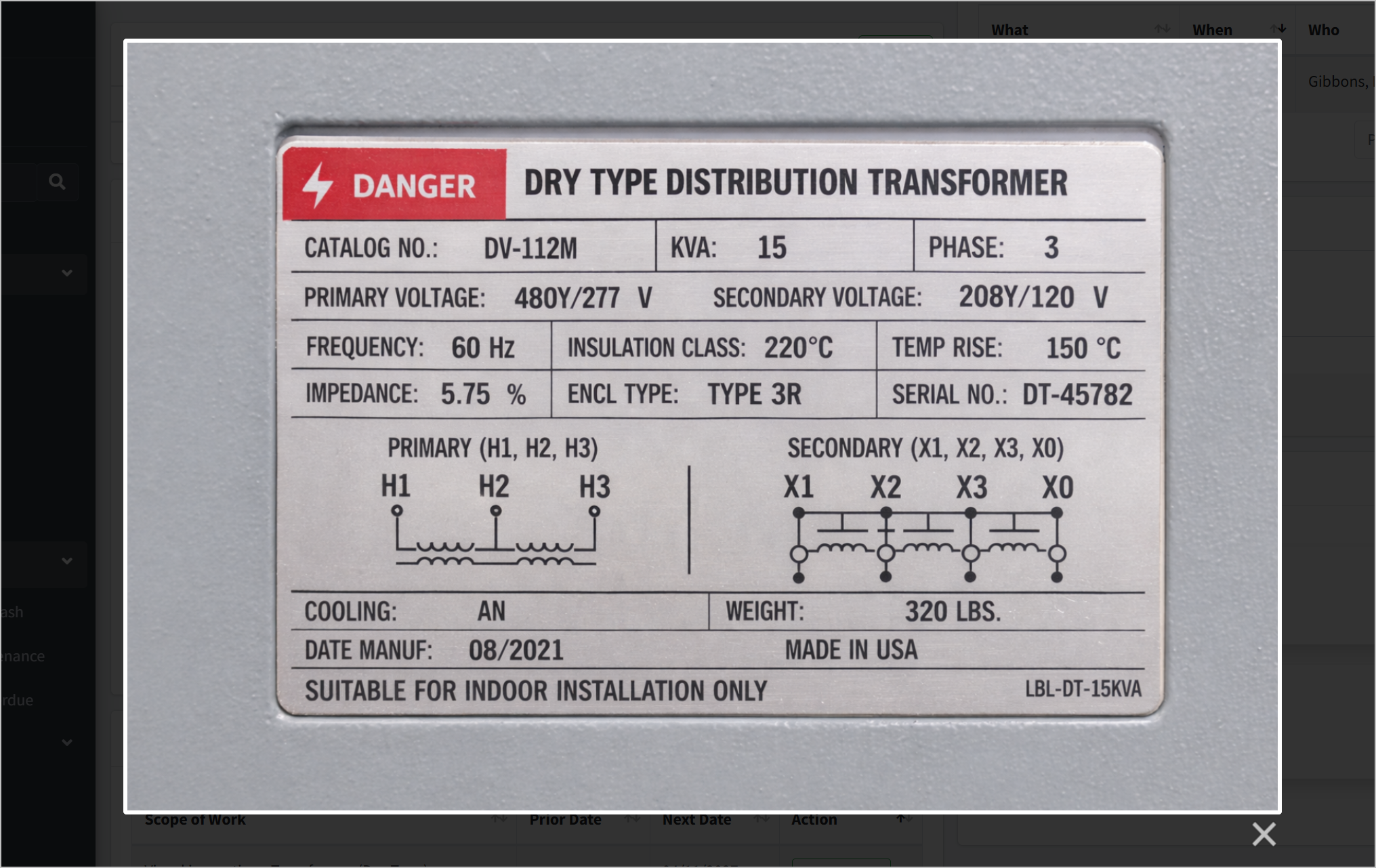
Photograph the Nameplate. Gimba Fills In the Rest.
Field technicians photograph equipment nameplates. Gimba pulls the manufacturer data from the image and auto-populates the asset record. No manual transcription, no data entry errors from the field.
You can also import from existing spreadsheets, SKM electrical study files, or PDF one-lines. Whatever data you already have, Gimba can work with it. See how asset tracking works in Gimba.
Step 2
Conduct Condition Assessments
The condition rating for each asset is determined by evaluating three factors: physical condition, criticality, and operating environment. The overall condition is the highest rating across all three. A device rated Condition 1 physically but installed in an environment it isn’t rated for gets assigned Condition 2 overall.
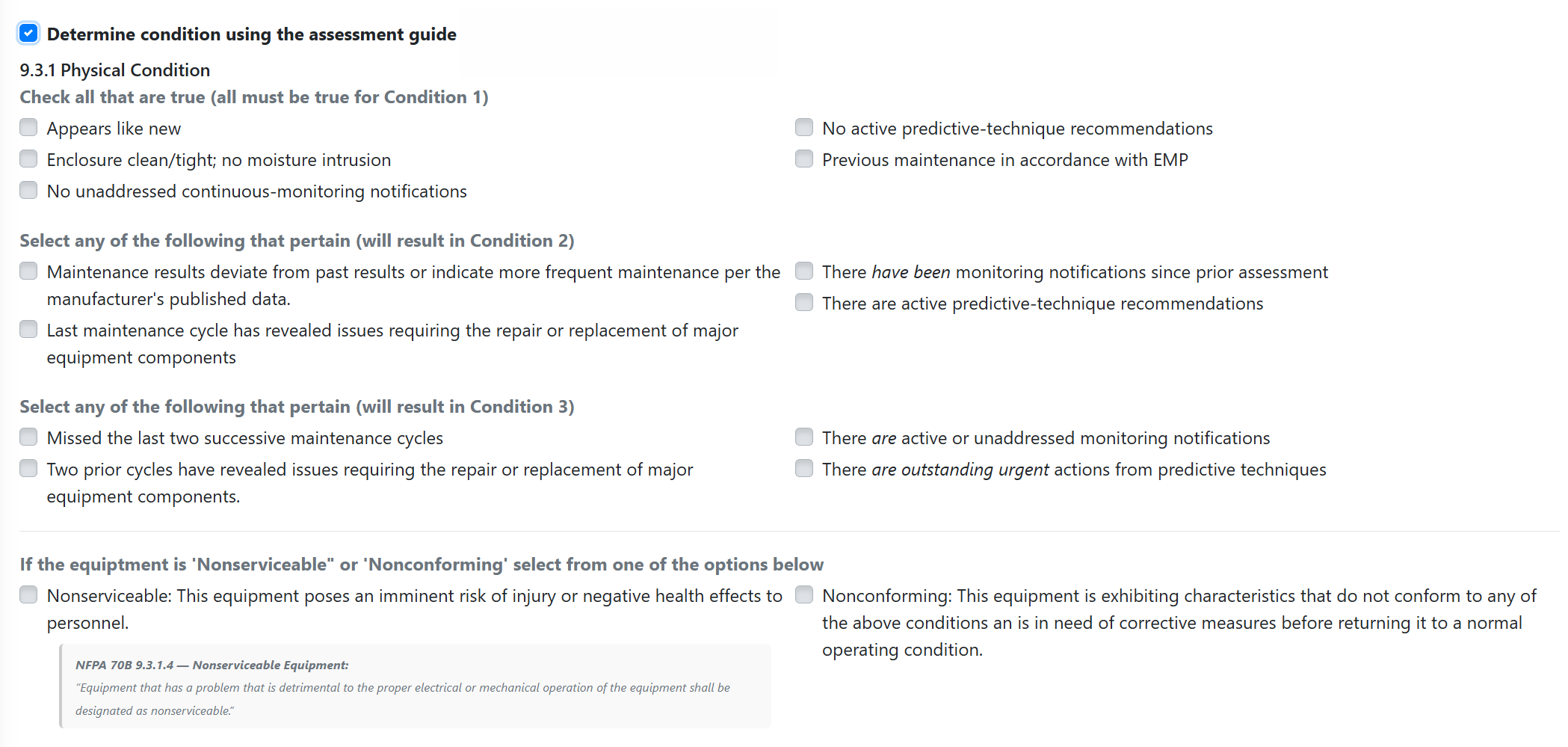
Physical condition has five criteria that must all be true for Condition 1: equipment appears like-new, the enclosure is clean and free from moisture, no unaddressed monitoring alerts, no active recommendations from predictive techniques, and previous maintenance was performed per the EMP. If any one of those fails, the equipment drops to Condition 2. Condition 3 means equipment has missed two successive maintenance cycles, is near end of service life, or requires urgent action. Beyond that, the standard also recognizes Nonserviceable (exceeded service life or poses imminent risk) and Nonconforming categories.
Criticality asks whether a failure will endanger personnel. Condition 3 criticality means yes. Operating environment checks whether the equipment is rated for where it’s actually installed. Harsh chemicals, extreme temperatures, or contamination not covered by the equipment rating push the rating up.
The condition rating isn’t just a label. It directly drives the maintenance interval from NFPA 70B Chapter 9. Your EMP must document the assessment results and the resulting schedule for every asset in scope. Read our condition assessment guide for a walkthrough of how this works in the field.
How Gimba Handles This
Guided Assessments. No 70B Expertise Needed.
Gimba’s AI-guided condition assessment walks technicians through each evaluation step using plain-language questions matched to the NFPA 70B criteria. The system applies the Condition 1/2/3 ratings automatically and sets the correct maintenance interval from Table 9.3.2 based on the result.
Assessments are completed in the field on any device. Results feed directly into the EMP, no transcription step.
Step 3
Set Maintenance Intervals and Build the Schedule
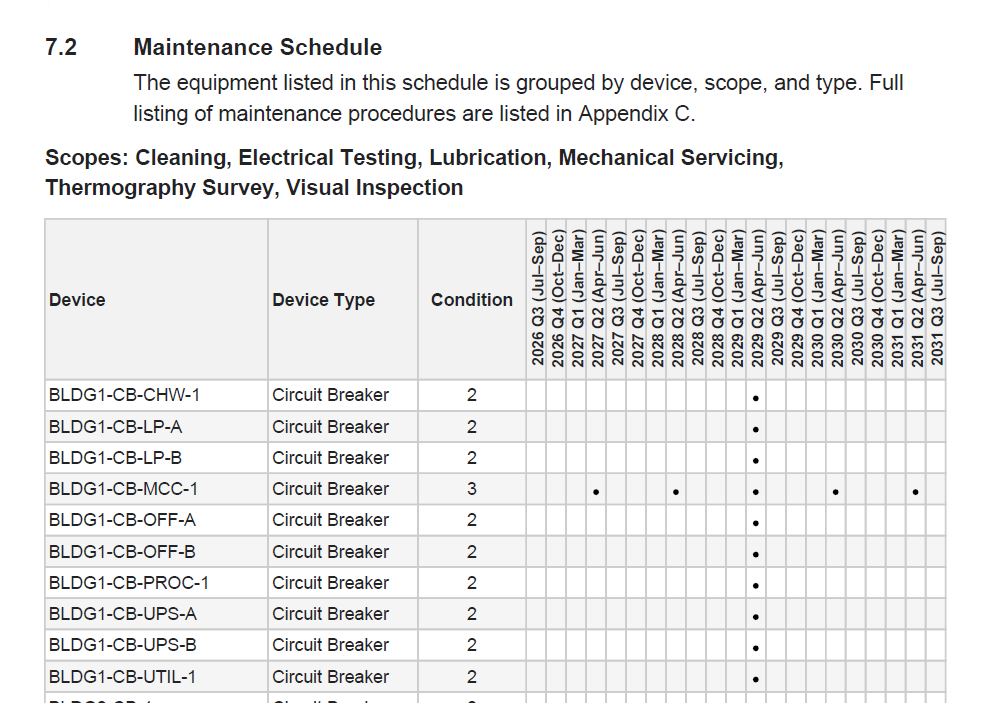
NFPA 70B doesn’t require a fixed annual inspection of every device. Intervals are risk-based, driven by device type and condition rating. Chapter 9 provides interval guidance by device category. For most distribution equipment (circuit breakers, panels, switchboards, transfer switches, disconnect switches), a full maintenance cycle runs every 60 months at Condition 1, every 36 months at Condition 2, and every 12 months at Condition 3. Infrared thermography runs annually on all equipment, and every 6 months for anything rated Condition 3.
Higher-risk equipment has tighter visual inspection requirements. Switchgear, transformers, substations, regulators, and reclosers require visual inspection every 12 months even at Condition 1. Full maintenance on those devices still follows the 60/36/12-month pattern, but you can’t go 5 years without a visual check on them regardless of condition rating.
Your EMP must document the maintenance schedule for each asset, tied to its condition rating. That makes the schedule a living document. It updates when condition ratings change after inspections. A facility that leaves every device on the same calendar-year cycle regardless of condition is non-compliant with the risk-based intent of the standard.
Section 4.2.4.2 also requires documented maintenance procedures for each equipment type. OEM manuals are the primary reference where they exist. When OEM documentation is unavailable, procedures should be built from NFPA 70B requirements and industry standards. OSHA’s electrical safety requirements reference this same documentation expectation.
How Gimba Handles This
Risk-Based Scheduling, Built In.
Gimba calculates maintenance intervals automatically using NFPA 70B Table 9.3.2 criteria. When a condition assessment updates a device rating, the schedule updates. No manual recalculation, no spreadsheet maintenance.
The maintenance schedule is included as a section of your generated EMP document, already formatted for auditor review.
Step 4
Assign and Document Responsible Personnel
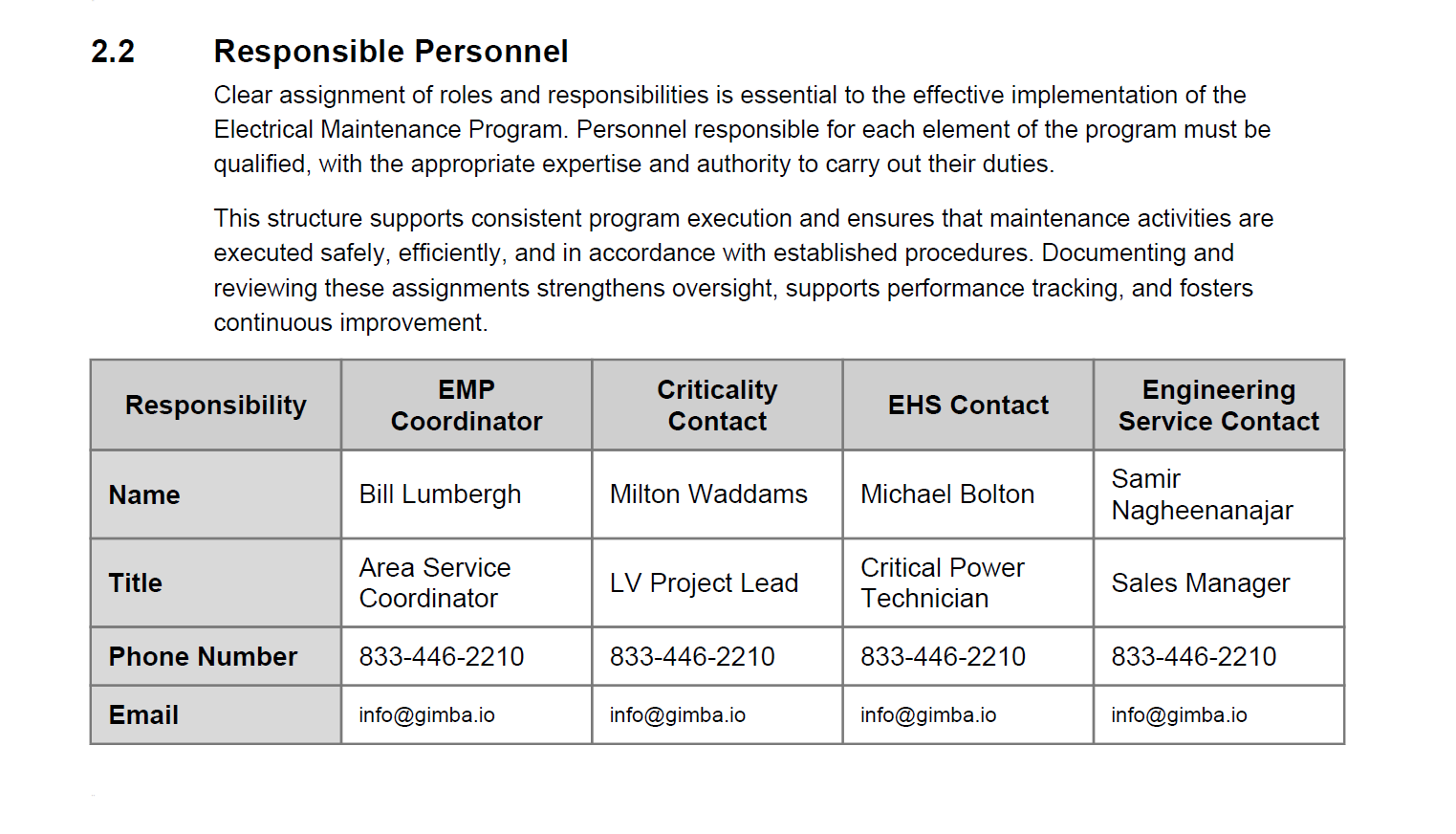
Section 4.2.4.2 requires identification of personnel responsible for each element of the program. Section 4.3.1 goes further, requiring a named EMP Coordinator accountable for implementation and day-to-day program operation.
This is a documentation requirement, not just an organizational one. The person’s name, role, and scope of responsibility must be in the EMP document itself. If the document doesn’t have a named coordinator with documented responsibilities, it fails Section 4.3.1 on that basis alone.
For larger organizations, responsibilities are typically distributed: the EMP Coordinator oversees the program, technicians conduct assessments, a facilities manager reviews corrective actions. All of that should be in the document.
How Gimba Handles This
Personnel Documentation, In the EMP.
Gimba includes a dedicated responsible personnel section in every generated EMP. It documents the EMP Coordinator and all assigned roles by name, satisfying the Section 4.2.4.2 and 4.3.1 requirements automatically.
When roles change, updating the EMP takes seconds, not a document revision process.
Step 5
Generate the EMP Document
With your asset inventory built, condition assessments complete, maintenance intervals set, and personnel documented, you have everything needed to produce the EMP document itself. This is the formal written program that satisfies NFPA 70B and what you’ll hand to auditors, insurers, and the AHJ when they ask.
A properly structured EMP document isn’t just a checklist – it’s a multi-section report. The executive summary covers program objectives, the facilities included, and a results and recommendations section that surfaces any compliance gaps. Section 2 covers the nine program elements individually: the electrical safety program, responsible personnel, equipment survey and analysis, maintenance procedures, the maintenance plan, records retention policy, corrective maintenance process, design for maintainability, and continuous improvement. Appendices carry the full condition assessment for every asset, device-by-device maintenance procedures per NFPA 70B, a quarterly maintenance schedule with target dates, records retention policy, and system study documentation.
Records your EMP needs to retain: maintenance logs and service histories, test results and inspection reports, equipment condition assessments, personnel training and qualification records, and work order documentation. A formal records retention policy defining how long each record type is kept is itself a required element under Section 4.2.4.2.
You can build one in Word. But keeping it current as equipment and personnel change becomes a manual process most facilities let slip. That’s when the program stops being compliant in practice even if it looks fine on paper.
For the full text of the standard, visit our NFPA 70B PDF downloads and resources page.
What a Completed Gimba EMP Looks Like
Professional. Formatted. Auditor-Ready.
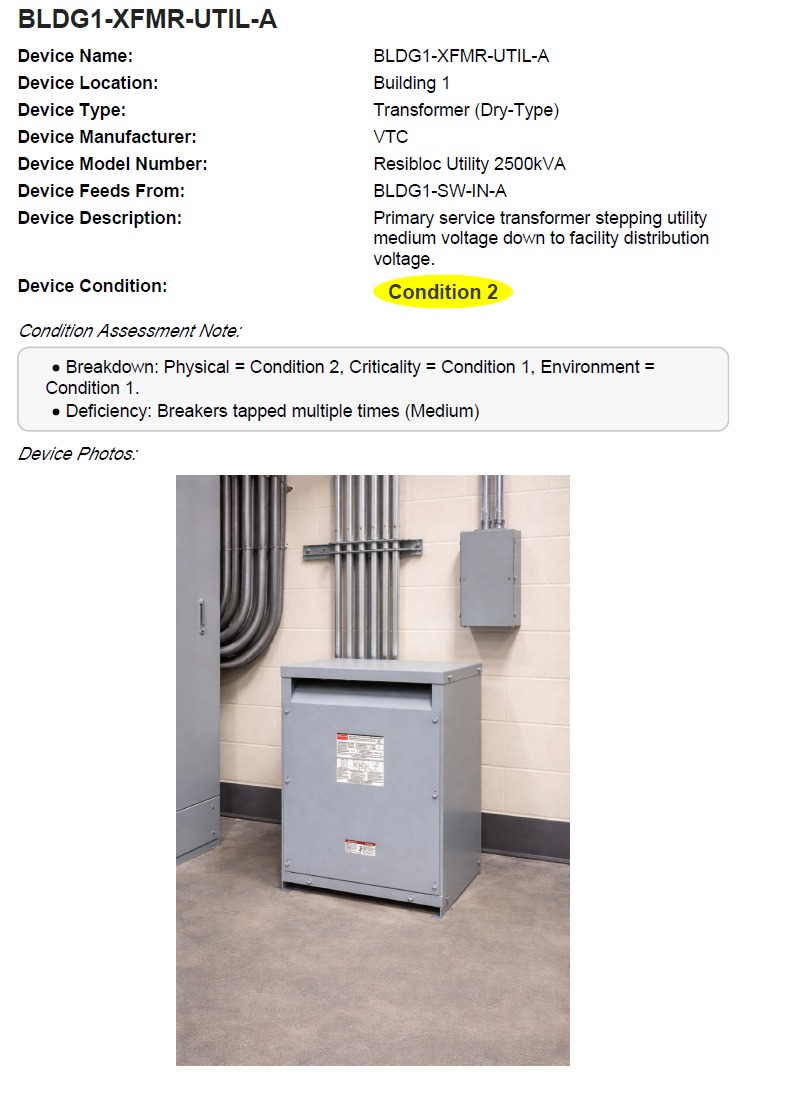
Gimba generates a complete EMP covering every required section: executive summary, program scope, full asset inventory, condition assessment results, risk-based maintenance schedule, maintenance procedures, responsible personnel, deficiency tracking, corrective action log, and records retention policy.
The format has received strong feedback from electrical industry experts familiar with the NFPA 70B standard. When an auditor asks for your program, you’re handing them a document built specifically for what they’re looking for.
Schedule a demo to see a real EMP generated on screen.
What the EMP Document Doesn’t Cover (But NFPA 70B Still Requires)
Generating the EMP document is not the same as full NFPA 70B compliance. The standard requires several supporting elements that exist outside the EMP document itself. These are the most common gaps that show up when a facility’s program is reviewed:
One-Line Diagrams
Facilities must maintain accurate, current one-line diagrams reflecting the actual electrical distribution system. Outdated or missing diagrams increase arc flash risk and complicate maintenance planning. NFPA 70B requires them to be updated any time the system changes.
Electrical System Studies
Short-circuit analysis, protective device coordination, and arc flash hazard assessments are required under NFPA 70B. These studies must be reviewed and updated at least every five years, or sooner after significant system changes. Without them, the protective devices in your facility may not be operating as intended.
Maintenance Plan Implementation
A maintenance schedule in the EMP document means nothing if inspections aren’t actually happening at those intervals. NFPA 70B requires the plan to be implemented, not just documented. Audit findings can cite facilities that have a written schedule but no evidence of execution.
Responsible Personnel Verification
The EMP Coordinator named in the document must be the actual person accountable for the program. If personnel changes and the document isn’t updated, the program fails Section 4.3.1. Contact information should also be current and verifiable.
Ready to Build Your EMP?
Most facilities complete a full, audit-ready Electrical Maintenance Program on their first day with Gimba. Same-day onboarding. Flat-rate pricing. No per-user fees.
Frequently Asked Questions
How long does it take to create an Electrical Maintenance Program?
With software, most facilities produce a complete, audit-ready EMP the same day they onboard. Building one manually with spreadsheets and Word templates takes weeks to months and often results in gaps that fail an audit. The bottleneck is usually data entry, not document creation.
What format does the EMP need to be in?
NFPA 70B doesn’t prescribe a specific format. The document must be written, comprehensive, and kept current. It must include all elements listed in Section 4.2.4.2 and be available to auditors, insurers, and the AHJ on demand.
Does the EMP need to be reviewed regularly?
Yes. Section 4.2.7 requires the EMP to be audited at intervals not exceeding 5 years. Any changes to the facility, equipment, or personnel also trigger a review. Software-driven EMPs stay current automatically because the underlying data is always live.
What is the difference between an EMP and a maintenance schedule?
A maintenance schedule is one component of the EMP. The full Electrical Maintenance Program also includes equipment inventory, condition assessment results, maintenance procedures, responsible personnel documentation, corrective action records, and the program review process. Many facilities have a schedule but not a program.
Is an EMP required for every facility?
Under NFPA 70B 2023, a documented EMP is required at any facility with significant electrical infrastructure. See our full NFPA 70B overview for a breakdown of who the standard applies to and what enforcement looks like. The short answer: if you have electrical distribution equipment, you need a program.
Related reading: NFPA 70B Overview | EMP Requirements Explained | Maintenance Intervals | Condition Assessment Guide | NFPA 70B Downloads
